.png)
Por favor, use este identificador para citar o enlazar este ítem:
https://hdl.handle.net/11000/40789Registro completo de metadatos
| Campo DC | Valor | Lengua/Idioma |
|---|---|---|
| dc.contributor.author | Sebastià, Albert | - |
| dc.contributor.author | Salgado Ramos, Manuel | - |
| dc.contributor.author | Pallarés, Noelia | - |
| dc.contributor.author | López Contreras, Samantha | - |
| dc.contributor.author | Garrigues, Sandra | - |
| dc.contributor.author | Tamayo Ramos, Juan A. | - |
| dc.contributor.author | Lucas González, Raquel | - |
| dc.contributor.author | Fernández López, Juana | - |
| dc.contributor.author | Barba, Francisco J. | - |
| dc.contributor.other | Departamentos de la UMH::Tecnología Agroalimentaria | es_ES |
| dc.date.accessioned | 2026-09-24T10:05:21Z | - |
| dc.date.available | 2026-09-24T10:05:21Z | - |
| dc.date.created | 2026 | - |
| dc.identifier.citation | ACS Omega | es_ES |
| dc.identifier.issn | 2470-1343 | - |
| dc.identifier.uri | https://hdl.handle.net/11000/40789 | - |
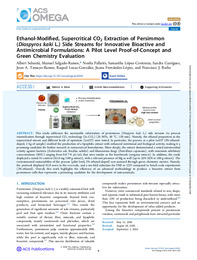
| dc.description.abstract | This study addresses the sustainable valorization of persimmon (Diospyros kaki L.) side streams via process intensification through supercritical CO2 technology (Sc-CO2) (35 MPa, 50 °C, 120 min). Namely, the ethanol proportion in the supercritical stream and different levels of operation (LoOP) were tested. In particular, the process at a pilot LoOP (2%-ethanoldoped, 2 kg of sample) enabled the production of a lipophilic extract with enhanced nutritional and biological activity, making it a promising candidate for further research in nutraceutical formulations. More deeply, the extract demonstrated a noted antimicrobial activity against bacteria (Escherichia coli, Bacillus subtilis) and filamentous fungi (Penicillium expansum), with minimum inhibitory concentrations (MIC) ranging from 0.8-7-8 μL/mL that were similar as the benchmark (oregano extract). In addition, the crude displayed a noted Fe content (85.8 mg/100 g extract), with a relevant presence of Mg as well (up to 52% RDI in 100 g extract). The environmental sustainability of the process (pilot level, 2%-ethanol-doped) was assessed through green chemistry metrics. Namely, the protocol displayed 45.9 score in the eco-scale, and a ten-fold reduction for PMI or CEF compared to bench scale experiments (2%-ethanol). Overall, this work highlights the efficiency of an advanced methodology to produce a bioactive extract from persimmon culls that represents a promising candidate for the development of nutraceuticals. | es_ES |
| dc.format | application/pdf | es_ES |
| dc.format.extent | 12 | es_ES |
| dc.language.iso | eng | es_ES |
| dc.publisher | American Chemical Society (ACS) | es_ES |
| dc.rights | info:eu-repo/semantics/openAccess | es_ES |
| dc.rights.uri | http://creativecommons.org/licenses/by-nc-nd/4.0/ | * |
| dc.subject | Process intensification | es_ES |
| dc.subject | Green Chemistry | es_ES |
| dc.subject | Persimmon oil | es_ES |
| dc.subject | Supercritical {CO}_2 | es_ES |
| dc.subject | Pilot scale | es_ES |
| dc.subject | Mineral profile | es_ES |
| dc.subject | Antimicrobial properties | es_ES |
| dc.subject.other | CDU::6 - Ciencias aplicadas::66 - Ingeniería, tecnología e industria química. Metalurgia::663/664 - Alimentos y nutrición. Enología. Aceites. Grasas | es_ES |
| dc.title | Ethanol-Modified, Supercritical $\text{CO}_2$ Extraction of Persimmon (Diospyros kaki L.) Side Streams for Innovative Bioactive and Antimicrobial Formulations: A Pilot Level Proof-of-Concept and Green Chemistry Evaluation | es_ES |
| dc.type | info:eu-repo/semantics/article | es_ES |
| dc.relation.publisherversion | https://doi.org/10.1021/acsomega.6c05435 | es_ES |
Ver/Abrir:
acsomega.6c05435.pdf
3,23 MB
Adobe PDF
Compartir:
 La licencia se describe como: Atribución-NonComercial-NoDerivada 4.0 Internacional.