.png)
Please use this identifier to cite or link to this item:
https://hdl.handle.net/11000/39972Full metadata record
| DC Field | Value | Language |
|---|---|---|
| dc.contributor.author | Pourmoradian, Amir | - |
| dc.contributor.author | Barzegar, Mohsen | - |
| dc.contributor.author | Carbonell-Barrachina, Ángel A. | - |
| dc.contributor.author | Noguera-Artiaga, Luis | - |
| dc.contributor.other | Departamentos de la UMH::Tecnología Agroalimentaria | es_ES |
| dc.date.accessioned | 2026-06-01T15:03:42Z | - |
| dc.date.available | 2026-06-01T15:03:42Z | - |
| dc.date.created | 2026-01 | - |
| dc.identifier.citation | Foods 2026, 15, 389 | es_ES |
| dc.identifier.issn | 2304-8158 | - |
| dc.identifier.uri | https://hdl.handle.net/11000/39972 | - |
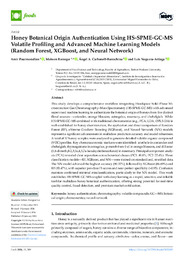
| dc.description.abstract | This study develops a comprehensive workflow integrating Headspace Solid-Phase Microextraction Gas Chromatography–Mass Spectrometry (HS-SPME-GC-MS) with advanced supervised machine learning to authenticate the botanical origin of honeys from five distinct floral sources—coriander, orange blossom, astragalus, rosemary, and chehelgiah. While HS-SPME-GC-MS combined with traditional chemometrics (e.g., PCA, LDA, OPLS-DA) is well-established for honey discrimination, the application and direct comparison of Random Forest (RF), eXtreme Gradient Boosting (XGBoost), and Neural Network (NN) models represent a significant advancement in multiclass prediction accuracy and model robustness. A total of 57 honey samples were analyzed to generate detailed volatile organic compound (VOC) profiles. Key chemotaxonomic markers were identified: anethole in coriander and chehelgiah, thymoquinone in astragalus, p-menth-8-en-1-ol in orange blossom, and dill ester (3,6-dimethyl-2,3,3a,4,5,7a-hexahydrobenzofuran) in rosemary. Principal component analysis (PCA) revealed clear separation across botanical classes (PC1: 49.8%; PC2: 22.6%). Three classification models—RF, XGBoost, and NN—were trained on standardized, stratified data. The NN model achieved the highest accuracy (90.32%), followed by XGBoost (86.69%) and RF (83.47%), with superior per-class F1-scores and near-perfect specificity (>0.95). Confusion matrices confirmed minimal misclassification, particularly in the NN model. This work establishes HS-SPME-GC-MS coupled with deep learning as a rapid, sensitive, and reliable tool for multiclass honey botanical authentication, offering strong potential for real-time quality control, fraud detection, and premium market certification. | es_ES |
| dc.format | application/pdf | es_ES |
| dc.format.extent | 14 | es_ES |
| dc.language.iso | eng | es_ES |
| dc.publisher | MDPI | es_ES |
| dc.rights | info:eu-repo/semantics/openAccess | es_ES |
| dc.rights.uri | http://creativecommons.org/licenses/by-nc-nd/4.0/ | * |
| dc.subject | honey authentication | es_ES |
| dc.subject | chromatography | es_ES |
| dc.subject | volatile compounds | es_ES |
| dc.subject | GC—MS | es_ES |
| dc.subject | botanical origin | es_ES |
| dc.subject | chemometrics | es_ES |
| dc.subject | neural network | es_ES |
| dc.title | Honey Botanical Origin Authentication Using HS-SPME-GC-MS Volatile Profiling and Advanced Machine Learning Models (Random Forest, XGBoost, and Neural Network) | es_ES |
| dc.type | info:eu-repo/semantics/article | es_ES |
| dc.relation.publisherversion | https://doi.org/10.3390/foods15020389 | es_ES |
View/Open:
foods-15-00389-v3.pdf
848,63 kB
Adobe PDF
Share:
