.png)
Por favor, use este identificador para citar o enlazar este ítem:
https://hdl.handle.net/11000/39970Registro completo de metadatos
| Campo DC | Valor | Lengua/Idioma |
|---|---|---|
| dc.contributor.author | Pérez López, Antonio José | - |
| dc.contributor.author | Noguera-Artiaga, Luis | - |
| dc.contributor.author | Navarro, Patricia | - |
| dc.contributor.author | Mompean, Pablo | - |
| dc.contributor.author | Van Lieshout, Alejandro | - |
| dc.contributor.author | Acosta Motos, José Ramón | - |
| dc.contributor.other | Departamentos de la UMH::Tecnología Agroalimentaria | es_ES |
| dc.date.accessioned | 2026-06-01T14:59:15Z | - |
| dc.date.available | 2026-06-01T14:59:15Z | - |
| dc.date.created | 2025-06 | - |
| dc.identifier.citation | Fermentation 2025, 11, 380 | es_ES |
| dc.identifier.issn | 2311-5637 | - |
| dc.identifier.uri | https://hdl.handle.net/11000/39970 | - |
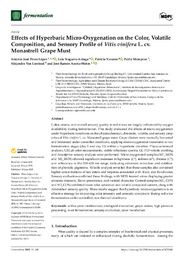
| dc.description.abstract | Color, aroma, and overall sensory quality in red wines are largely influenced by oxygen availability during fermentation. This study evaluated the effects of micro-oxygenation under hyperbaric conditions on the physicochemical, chromatic, volatile, and sensory properties of Vitis vinifera L. cv. Monastrell grape must. Grape clusters were manually harvested and fermented under controlled conditions, applying micro-oxygenation treatments at two fermentation stages (day 3 and day 13) within a hyperbaric chamber. Physicochemical analyses, CIELab color measurements, visible reflectance spectra, GC-FID volatile profiling, and descriptive sensory analysis were performed. Micro-oxygenated samples (M1_MOX and M2_MOX) showed significant increases in lightness (L*), redness (a*), chroma (C*), and reflectance in the 520–620 nm range, indicating enhanced extraction and stabilization of phenolic pigments. Volatile analysis revealed that these samples also contained higher concentrations of key esters and terpenes associated with fruity and floral notes. Sensory evaluation confirmed these findings, with MOX-treated wines displaying greater aromatic intensity, flavor persistence, and varietal character. Control samples (M1_CON and M2_CON) exhibited lower color saturation and volatile compound content, along with diminished sensory quality. These results suggest that hyperbaric micro-oxygenation is an effective strategy for improving color intensity and aromatic complexity during red wine fermentation under controlled, non-thermal conditions. | es_ES |
| dc.format | application/pdf | es_ES |
| dc.format.extent | 18 | es_ES |
| dc.language.iso | eng | es_ES |
| dc.publisher | MDPI | es_ES |
| dc.rights | info:eu-repo/semantics/openAccess | es_ES |
| dc.rights.uri | http://creativecommons.org/licenses/by-nc-nd/4.0/ | * |
| dc.subject | anthocyanin stabilization | es_ES |
| dc.subject | enological innovation | es_ES |
| dc.subject | grape aroma | es_ES |
| dc.subject | high-pressure processing | es_ES |
| dc.subject | must fermentation | es_ES |
| dc.subject | sensory evaluation | es_ES |
| dc.subject | yeast metabolism | es_ES |
| dc.title | Effects of Hyperbaric Micro-Oxygenation on the Color, Volatile Composition, and Sensory Profile of Vitis vinifera L. cv. Monastrell Grape Must | es_ES |
| dc.type | info:eu-repo/semantics/article | es_ES |
| dc.relation.publisherversion | https://doi.org/10.3390/fermentation11070380 | es_ES |
Ver/Abrir:
fermentation-11-00380-v2.pdf
674,69 kB
Adobe PDF
Compartir:
 La licencia se describe como: Atribución-NonComercial-NoDerivada 4.0 Internacional.