.png)
Please use this identifier to cite or link to this item:
https://hdl.handle.net/11000/40330Full metadata record
| DC Field | Value | Language |
|---|---|---|
| dc.contributor.author | Mira, José Joaquín | - |
| dc.contributor.author | Pérez-Esteve, Clara | - |
| dc.contributor.author | Gil-Hernández, Eva | - |
| dc.contributor.author | Arroyo-Rodríguez, Almudena | - |
| dc.contributor.author | Aranaz-Andrés, Jesús María | - |
| dc.contributor.author | Ballester, Purificación | - |
| dc.contributor.author | Carrillo, Irene | - |
| dc.contributor.other | Departamentos de la UMH::Psicología de la Salud | es_ES |
| dc.date.accessioned | 2026-08-31T11:01:31Z | - |
| dc.date.available | 2026-08-31T11:01:31Z | - |
| dc.date.created | 2026-07-09 | - |
| dc.identifier.citation | Journal of Medical Internet Research 2026 | vol. 28 | e85141 | | es_ES |
| dc.identifier.issn | 1438-8871 | - |
| dc.identifier.uri | https://hdl.handle.net/11000/40330 | - |
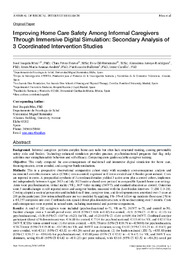
| dc.description.abstract | Background: Informal caregivers perform complex home-care tasks but often lack structured training, causing preventable safety risks and burden. Technology-enhanced simulation provides practice; psychoeducational programs that flag risky activities may strengthen safety behaviors and self-efficacy. Comparing costs guides scalable caregiver training. Objective: This study compared the cost-consequences of traditional and immersive digital simulation for home care, focusing on costs, errors avoided, and caregiver-burden reduction. Methods: This is a prospective observational comparative cohort study with secondary cost-consequence analysis and incremental cost-effectiveness ratios (ICERs) versus control, expressed in €/error avoided and €/burden point reduced. Costs are reported in euros. A prespecified synthesis of 3 coordinated studies yielded 3 active arms plus a control cohort, implemen ted independently between August 2023 and July 2025 under a shared core protocol in comparable Spanish home-care settings. Arms were psychoeducation, virtual reality (VR), 360° video training (360VT), and standard education as control. Outcomes were 3-month changes in self-reported errors and caregiver burden, measured with the Zarit Burden Interview-7 (ZBI-7; 0–28). Costing adopted a societal perspective and included staff time, caregiver time, and development costs amortized over 3 years at 200 participants/year. Downstream health care use was modeled by applying 1%–5% of follow-up incidents (base case 2%) to a €1,257 composite unit cost. Combined costs equaled direct plus downstream costs, with no discounting over 3 months. Costs and consequences were reported in natural units, including incremental and pairwise comparisons. Results: A total of 282 caregivers were included (psychoeducational n=71, VR n=70, 360VT n=71, and control n=70). Incident changes over a 3-month period were: +0.44 (95% CI 0.06 to 0.82) for control, −0.51 (95% CI −0.89 to −0.13) for psychoeducational, −0.56 (95% CI −0.97 to −0.20) for VR, and −0.20 (95% CI −0.66 to 0.09) for 360VT. Combined cost/per participant (direct +2% downstream) was: €46.88 for control, €77.04 for psychoeducational, €105.60 for VR, and €42.97 for 360VT. ICERs versus control were: (1) for errors avoided, —€31.75/error (95% CI €19.78 to −€54.98) for psychoeducation, €58.72/error (95% CI €39.40 to −€97.89) for VR, and 360VT was dominant, saving €6.11 (95% CI €4.24 to −€10.63) per error avoided, with €3.91 (95% CI €3.52 to −€4.29) saved per participant; (2) for burden reduced (ZBI-7), −€55.85/point (95% CI €38.27 to −€98.68) for psychoeducational, €45.88/point (95% CI €32.12 to −€76.67) for VR, and 360VT was dominant, saving €6.41 (95% CI €4.42 to −€11.23) per point reduced, with €3.91 (95% CI €3.52 to −€4.29) saved per participant. Pairwise for burden were as follows: (1) VR versus psychoeducational, €38.59 (95% CI €26.89 to −€66.13) per extra point; (2) 360VT versus psychoeducational dominant; and (3) VR versus 360VT, €93.48 (95% CI €64.41 to −€163.85) per extra point. Conclusions: This real-world cost-consequence analysis innovatively compares immersive and nonimmersive training for informal caregivers from a societal perspective, using harmonized safety, burden, and downstream cost outcomes. Findings support stepped adoption: 360VT as a scalable default, VR for higher-risk tasks or caregivers with greater burden, and psychoeducation as a complementary low-cost strategy when resources are constrained. | es_ES |
| dc.format | application/pdf | es_ES |
| dc.format.extent | 19 | es_ES |
| dc.language.iso | eng | es_ES |
| dc.publisher | JMIR Publications | es_ES |
| dc.rights | info:eu-repo/semantics/openAccess | es_ES |
| dc.rights | Attribution-NonCommercial-NoDerivatives 4.0 Internacional | * |
| dc.rights.uri | http://creativecommons.org/licenses/by-nc-nd/4.0/ | * |
| dc.subject | informal caregivers | es_ES |
| dc.subject | home care | es_ES |
| dc.subject | patient safety | es_ES |
| dc.subject | psychoeducational training | es_ES |
| dc.subject | virtual reality | es_ES |
| dc.subject | augmented reality | es_ES |
| dc.subject | cost-consequence analysis | es_ES |
| dc.subject | caregiver burden | es_ES |
| dc.subject.other | CDU::1 - Filosofía y psicología::159.9 - Psicología | es_ES |
| dc.title | Improving Home Care Safety Among Informal Caregivers Through Immersive Digital Simulation: Secondary Analysis of 3 Coordinated Intervention Studies | es_ES |
| dc.type | info:eu-repo/semantics/article | es_ES |
| dc.relation.publisherversion | https://doi.org/10.2196/85141 | es_ES |
View/Open:
12. Mira et al. - 2026 - Improving Home Care.pdf
318,93 kB
Adobe PDF
Share:
