Título :
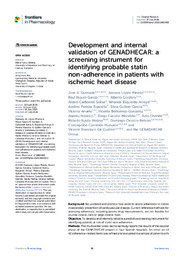
Development and internal validation of GENADHECAR: a screening instrument for identifying probable statin
non-adherence in patients with ischemic heart disease |
Autor :
Quesada, Jose A.
López-Pineda, Adriana
NOUNI GARCÍA, RAUF 
Cordero, Alberto
Carbonell Soliva, Álvaro
Esquerdo Arroyo, Amanda
PEREIRA-EXPOSITO, AVELINO
Guillen-García, Silvia
Arrarte, Vicente
Bertomeu-Gonzalez, Vicente
Nolasco, Andreu
Cazorla-Morallon, Diego
Osende, Julio
nalda-molina, Ricardo
Orozco-Beltrán, Domingo
Carratalá-Munuera, Concepción
Gil-Guillén, Vicente F |
Editor :
Frontiers Media S.A. |
Departamento:
Departamentos de la UMH::Medicina Clínica
Departamentos de la UMH::Patología y Cirugía |
Fecha de publicación:
2026-07-27 |
URI :
https://hdl.handle.net/11000/40320 |
Resumen :
Background: No validated and practical tool exists to assess adherence to statins
in secondary prevention of cardiovascular disease. Current reference methods for
assessing adherence, including plasma drug measurements, are not feasible for
routine clinical care or large clinical trials.
Objective: To develop and internally validate a predictive screening instrument for
identifying patients at risk of statin non-adherence.
Methods: This multicenter cross-sectional study reports the results of the second
phase of the GENADHECAR project in four Spanish hospitals. An initial set of
42 adherence-related items was refined and evaluated in a sample of patients with ischemic heart disease. Responses were compared against a pharmacokinetic reference method (plasma statin concentrations) to assess recent medication intake. A multivariate predictive model of non-adherence was then developed, selecting the best predictors and covariates to be included in the final screening instrument.
Results:
A total of 309 patients were included, of whom 49 (15.9%) were classified as non-adherent according to the pharmacokinetic reference method. The final GENADHECAR screening instrument comprised three questionnaire items (use of reminders, forgetfulness, and medication access) and two sociodemographic variables (sex and educational attainment). Internal bootstrap validation yielded an optimism-corrected AUC of 0.694 (95% CI 0.617–0.767), with adequate calibration (Hosmer–Lemeshow p = 0.994). At the selected probability threshold (0.15), sensitivity was 0.73, specificity 0.61, and positive and negative predictive values were 0.26 and 0.92, respectively. Overall, the model showed moderate discrimination and a high capacity to identify patients at low risk of non-adherence.
Conclusion:
To our knowledge, GENADHECAR is the first screening instrument with internal validation to identify statin non-adherence using a pharmacokinetic reference method. It offers a brief and practical approach for identifying patients at risk of non-adherence and may help overcome some limitations of conventional self-report methods in this population. Further external validation is needed before routine clinical implementation.
|
Palabras clave/Materias:
coronary artery disease
disease management
medication compliance
medication therapy management
secondary prevention
sex factors |
Tipo de documento :
info:eu-repo/semantics/article |
Derechos de acceso:
info:eu-repo/semantics/openAccess
Attribution-NonCommercial-NoDerivatives 4.0 Internacional |
DOI :
doi: 10.3389/fphar.2026.1860683 |
Publicado en:
Front. Pharmacol. 17:1860683 |
Aparece en las colecciones:
Artículos Medicina Clínica
|
.png)
 La licencia se describe como: Atribución-NonComercial-NoDerivada 4.0 Internacional.