.png)
Por favor, use este identificador para citar o enlazar este ítem:
https://hdl.handle.net/11000/40209Registro completo de metadatos
| Campo DC | Valor | Lengua/Idioma |
|---|---|---|
| dc.contributor.author | Bonte, S. M. | - |
| dc.contributor.author | Coves, A. | - |
| dc.contributor.author | San-Blas, A. A. | - |
| dc.contributor.author | Vague, J. J. | - |
| dc.contributor.author | Boria, V. E. | - |
| dc.contributor.other | Departamentos de la UMH::Ingeniería de Comunicaciones | es_ES |
| dc.date.accessioned | 2026-07-16T14:42:59Z | - |
| dc.date.available | 2026-07-16T14:42:59Z | - |
| dc.date.created | 2026 | - |
| dc.identifier.citation | AEU - International Journal of Electronics and Communications, 2026, Article: 156466, Volume 216 | es_ES |
| dc.identifier.issn | 1618-0399 | - |
| dc.identifier.issn | 1434-8411 | - |
| dc.identifier.uri | https://hdl.handle.net/11000/40209 | - |
| dc.description | Preprint | es_ES |
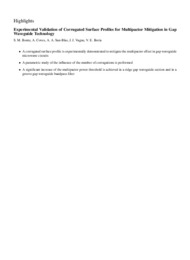
| dc.description.abstract | This work presents the design, fabrication, and experimental validation of corrugated surface profiles to mitigate the multipactor effect in gap waveguide technology. Two representative structures – a ridge gap waveguide (RGW) section and a groove gap waveguide (GGW) bandpass filter – are investigated. Corrugations are introduced in regions of maximum electric field to disrupt electron trajectories and increase the multipactor threshold power. A comprehensive study combining full-wave electromagnetic simulations and particle tracking is carried out to evaluate their impact on RF performance and multipactor susceptibility. Different corrugation configurations are assessed to achieve an optimal trade-off between improved power-handling capability and minimal electrical degradation. Prototypes are manufactured using standard CNC milling and experimentally tested under high-power vacuum conditions. Results show a significant increase in multipactor threshold power (about 1.5–2 kW) in both RGW and GGW structures, while maintaining low insertion loss and high return loss. The good agreement between simulations and measurements confirms the effectiveness of this simple, passive, and effective solution for enhancing the power-handling capability of gap waveguide components. The main contribution of this work is the application of corrugated profiles for multipactor mitigation, along with its experimental validation using practical RGW and GGW components. | es_ES |
| dc.format | application/pdf | es_ES |
| dc.format.extent | 14 | es_ES |
| dc.language.iso | eng | es_ES |
| dc.publisher | Elsevier | es_ES |
| dc.rights | info:eu-repo/semantics/openAccess | es_ES |
| dc.rights.uri | http://creativecommons.org/licenses/by-nc-nd/4.0/ | * |
| dc.subject | gap waveguide technology | es_ES |
| dc.subject | microwave | es_ES |
| dc.subject | multipactor mitigation | es_ES |
| dc.subject.other | CDU::6 - Ciencias aplicadas::62 - Ingeniería. Tecnología | es_ES |
| dc.title | Experimental Validation of Corrugated Surface Profiles for Multipactor Mitigation in Gap Waveguide Technology | es_ES |
| dc.type | info:eu-repo/semantics/article | es_ES |
| dc.relation.publisherversion | https://doi.org/10.1016/j.aeue.2026.156466 | es_ES |
Ver/Abrir:
Experimental Validation_revised.pdf
5,59 MB
Adobe PDF
Compartir:
 La licencia se describe como: Atribución-NonComercial-NoDerivada 4.0 Internacional.