.png)
Por favor, use este identificador para citar o enlazar este ítem:
https://hdl.handle.net/11000/40120Registro completo de metadatos
| Campo DC | Valor | Lengua/Idioma |
|---|---|---|
| dc.contributor.author | Aracil Marco, Adolfo | - |
| dc.contributor.author | Sarabia, José Manuel | - |
| dc.contributor.author | Pastor, Diego | - |
| dc.contributor.author | Guillén, Silvia | - |
| dc.contributor.author | López-Grueso, Raúl | - |
| dc.contributor.author | Gallar, Juana | - |
| dc.contributor.author | Moya-Ramón, Manuel | - |
| dc.contributor.other | Departamentos de la UMH::Ciencias del Deporte | es_ES |
| dc.contributor.other | Departamentos de la UMH::Medicina Clínica | es_ES |
| dc.date.accessioned | 2026-06-23T10:56:01Z | - |
| dc.date.available | 2026-06-23T10:56:01Z | - |
| dc.date.created | 2021-08 | - |
| dc.identifier.citation | Biology (Basel) . 2021 Aug 17;10(8):783 | es_ES |
| dc.identifier.issn | 2079-7737. | - |
| dc.identifier.uri | https://hdl.handle.net/11000/40120 | - |
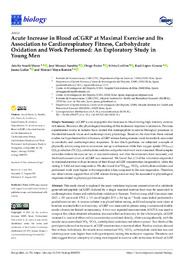
| dc.description.abstract | This study aimed to explore if the acute variations in plasma concentration of α-calcitonin gene-related peptide (αCGRP) induced by a single maximal exercise bout may be associated to cardiorespiratory fitness and carbohydrate oxidation in humans. Twelve young adult Caucasian men (24.3 ± 0.9 years-old; 179.2 ± 1.9 cm of height; 23.9 ± 0.6 kg·m-2 body mass index) performed a graded exercise test. A venous catheter was placed before testing, and blood samples were taken at baseline, maximal effort and recovery. αCGRP was measured in plasma using a commercial double-sandwich enzyme-linked-immunoassay. A two-way repeated measurements ANOVA was used to compare the values obtained at baseline, maximal effort and recovery. In the whole sample, αCGRP increased at maximal effort and its concentration correlated directly, albeit non-significantly, with the muscle mass normalised VO2, VCO2, carbohydrate oxidation and relative power. Two thirds of the participants showed an increase in αCGRP concentration at maximal effort. Post hoc analysis showed that in these individuals, the muscle mass normalised VO2, VCO2, carbohydrate oxidation rate and relative power were higher than in the participants lacking this molecular response. Therefore, our data suggest that (a) a majority of young men respond to exercise with an increase in blood αCGRP concentration; and (b) individuals exhibiting this response also show a higher cardiorespiratory fitness, carbohydrate oxidation and work performed. These findings suggest that this neuropeptide could act as an exerkine with potential effects on physical performance. | es_ES |
| dc.format | application/pdf | es_ES |
| dc.format.extent | 12 | es_ES |
| dc.language.iso | eng | es_ES |
| dc.publisher | MDPI | es_ES |
| dc.rights | info:eu-repo/semantics/openAccess | es_ES |
| dc.rights.uri | http://creativecommons.org/licenses/by-nc-nd/4.0/ | * |
| dc.subject | VO2max | es_ES |
| dc.subject | arbohydrate oxidation | es_ES |
| dc.subject | cardiorespiratory fitness | es_ES |
| dc.subject.other | CDU::6 - Ciencias aplicadas::61 - Medicina | es_ES |
| dc.subject.other | CDU::7 - Deportes | es_ES |
| dc.title | Acute Increase in Blood αCGRP at Maximal Exercise and Its Association to Cardiorespiratory Fitness, Carbohydrate Oxidation and Work Performed: An Exploratory Study in Young Men | es_ES |
| dc.type | info:eu-repo/semantics/article | es_ES |
| dc.contributor.institute | Institutos de la UMH::Instituto de Neurociencias | es_ES |
| dc.relation.publisherversion | 10.3390/biology10080783 | es_ES |
Ver/Abrir:
Acute Increase in Blood CGRP at Maximal Exercise and Its.pdf
742,38 kB
Adobe PDF
Compartir:
 La licencia se describe como: Atribución-NonComercial-NoDerivada 4.0 Internacional.