.png)
Please use this identifier to cite or link to this item:
https://hdl.handle.net/11000/39566Full metadata record
| DC Field | Value | Language |
|---|---|---|
| dc.contributor.author | Beltrá, Marta | - |
| dc.contributor.author | Borrás, Fernando | - |
| dc.contributor.author | Ropero, Ana B. | - |
| dc.contributor.other | Departamentos de la UMH::Biología Aplicada | es_ES |
| dc.date.accessioned | 2026-03-18T14:35:23Z | - |
| dc.date.available | 2026-03-18T14:35:23Z | - |
| dc.date.created | 2021-09 | - |
| dc.identifier.citation | Nutrients, Vol. 13, Nº 10 (2021) | es_ES |
| dc.identifier.issn | 2072-6643 | - |
| dc.identifier.uri | https://hdl.handle.net/11000/39566 | - |
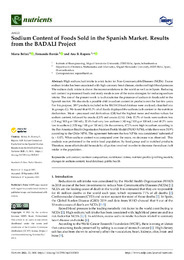
| dc.description.abstract | High sodium/salt intake is a risk factor for Non-Communicable Diseases (NCDs). Excess sodium intake has been associated with high coronary heart disease, stroke and high blood pressure. The sodium daily intake is above the recommendations in the world as well as in Spain. Reducing salt content in processed foods and ready meals is one of the main strategies for reducing sodium intake. The aim of the present work is to characterise the presence of sodium in foods sold in the Spanish market. We also study a possible shift in sodium content in products over the last few years. For this purpose, 3897 products included in the BADALI food database were analysed, classified into 16 groups (G).We found that 93.3% of all foods displayed the sodium/salt content in the nutrition declaration. Meat—processed and derivatives (G8) had the highest mean and median values for sodium content, followed by snacks (G15) and sauces (G14). Only 12.7% of foods were sodium-free ( 5 mg/100 g or 100 mL), 32.4% had very low sodium ( 40 mg/100 g or 100 mL) and 48.2% were low in sodium ( 120 mg/100 g or 100 mL). On the contrary, 47.2% were high in sodium according to the Pan American Health Organisation Nutrient Profile Model (PAHO-NPM), while there were 31.9% according to the Chile-NPM. The agreement between the two NPMs was considered ‘substantial’ ( = 0.67). When sodium content was compared over the years, no decrease was observed. This analysis was performed in the entire food population, by food group and in matched products. Therefore, more effort should be made by all parties involved in order to decrease the sodium/salt intake in the population. | es_ES |
| dc.format | application/pdf | es_ES |
| dc.format.extent | 22 | es_ES |
| dc.language.iso | eng | es_ES |
| dc.publisher | MDPI | es_ES |
| dc.rights | info:eu-repo/semantics/openAccess | es_ES |
| dc.rights.uri | http://creativecommons.org/licenses/by-nc-nd/4.0/ | * |
| dc.subject | salt content | es_ES |
| dc.subject | nutrient composition | es_ES |
| dc.subject | nutritional claims | es_ES |
| dc.subject | nutrient profile/profiling models | es_ES |
| dc.subject | changes in sodium content | es_ES |
| dc.subject | food database | es_ES |
| dc.subject | public health | es_ES |
| dc.subject.other | CDU::6 - Ciencias aplicadas::66 - Ingeniería, tecnología e industria química. Metalurgia::663/664 - Alimentos y nutrición. Enología. Aceites. Grasas | es_ES |
| dc.title | Sodium Content of Foods Sold in the Spanish Market. Results from the BADALI Project | es_ES |
| dc.type | info:eu-repo/semantics/article | es_ES |
| dc.relation.publisherversion | https://doi.org/10.3390/nu13103410 | es_ES |
Ver/Abrir:
nutrients-13-03410-v3_todo.pdf
966,4 kB
Adobe PDF
Compartir:
 La licencia se describe como: Atribución-NonComercial-NoDerivada 4.0 Internacional.