.png)
Por favor, use este identificador para citar o enlazar este ítem:
https://hdl.handle.net/11000/39250Registro completo de metadatos
| Campo DC | Valor | Lengua/Idioma |
|---|---|---|
| dc.contributor.author | Flores, María | - |
| dc.contributor.author | Payá, Luis | - |
| dc.contributor.author | Valiente, David | - |
| dc.contributor.author | Gallego, Julio | - |
| dc.contributor.author | Reinoso, Oscar | - |
| dc.contributor.other | Departamentos de la UMH::Ingeniería de Comunicaciones | es_ES |
| dc.date.accessioned | 2026-02-12T17:46:00Z | - |
| dc.date.available | 2026-02-12T17:46:00Z | - |
| dc.date.created | 2019 | - |
| dc.identifier.citation | Electronics, Vol 8, Nº 11 (2019) | es_ES |
| dc.identifier.issn | 2079-9292 | - |
| dc.identifier.uri | https://hdl.handle.net/11000/39250 | - |
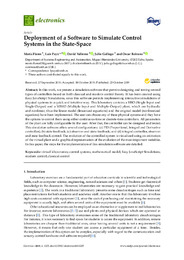
| dc.description.abstract | In this work, we present a simulation software that permits designing and testing several types of controllers based on both classical and modern control theory. It has been created using Easy JavaScript Simulations, since this software permits implementing interactive simulations of physical systems in a quick and intuitive way. This laboratory contains a SISO (Single-Input and Single-Output) and a MIMO (Multiple-Input and Multiple-Output) plant, which are hydraulic and nonlinear, thus the linear model (linearized equations) and the original model (nonlinerized equations) have been implemented. The user can choose any of these physical systems and they have the options to control them using either continuous-time or discrete-time controllers. All parameters of the plant are fully configurable by the user. After that, the controller can be designed and tested. This simulation software offers several configurations: (a) PID (Proportional, Integral and Derivative controller); (b) state feedback; (c) observer and state feedback; and (d) integral controller, observer and state feedback control. The evolution of the controlled system is visualized using an animation of the virtual plant and a graphical representation of the evolution of the most important variables. In this paper, the steps for the implementation of this simulation software are detailed. | es_ES |
| dc.format | application/pdf | es_ES |
| dc.format.extent | 28 | es_ES |
| dc.language.iso | eng | es_ES |
| dc.publisher | MDPI | es_ES |
| dc.rights | info:eu-repo/semantics/openAccess | es_ES |
| dc.rights.uri | http://creativecommons.org/licenses/by-nc-nd/4.0/ | * |
| dc.subject | virtual laboratories | es_ES |
| dc.subject | control systems | es_ES |
| dc.subject | mathematical model | es_ES |
| dc.subject | Easy JavaScript Simulations | es_ES |
| dc.subject | modern control | es_ES |
| dc.subject | classical control | es_ES |
| dc.subject.other | CDU::6 - Ciencias aplicadas::62 - Ingeniería. Tecnología::621 - Ingeniería mecánica en general. Tecnología nuclear. Electrotecnia. Maquinaria::621.3 - Ingeniería eléctrica. Electrotecnia. Telecomunicaciones | es_ES |
| dc.title | Deployment of a Software to Simulate Control Systems in the State-Space | es_ES |
| dc.type | info:eu-repo/semantics/article | es_ES |
| dc.relation.publisherversion | https://doi.org/10.3390/electronics8111205 | es_ES |
Ver/Abrir:
Deployment of a Software to Simulate Control Systems.pdf
1,45 MB
Adobe PDF
Compartir:
 La licencia se describe como: Atribución-NonComercial-NoDerivada 4.0 Internacional.