Título :
Factors associated with the occupational balance in caregivers of people with dementia: A cross-sectional study from the ATENEA project |
Autor :
Prieto Botella, Daniel
Fernández Pires, Paula
Peral-Gómez, Paula 
Espinosa-Sempere, Cristina
Company Devesa, Verónica
Pastor Zaplana, Jose Angel
González-Román, Loreto
Garrido-Pedrosa, Jessica
ZANGO MARTÍN, INMACULADA
Wagman, Petra
Sánchez-Pérez, Alicia |
Editor :
Springer Nature |
Departamento:
Departamentos de la UMH::Patología y Cirugía |
Fecha de publicación:
2024-11 |
URI :
https://hdl.handle.net/11000/39147 |
Resumen :
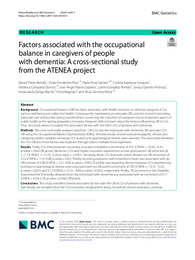
Background: Occupational balance (OB) has been associated with health indicators in informal caregivers (CGs) such as well-being and subjective health. Consequently, maintaining an adequate OB could be crucial to providing adequate care without becoming overwhelmed, converting the condition of caregivers into an important aspect of public health as the ageing population increases. However, little is known about the factors influencing OB in CGs. Thus, this study aimed to explore the associated factors with the OB in CGs of persons with dementia. Methods: We cross-sectionally analysed data from 134 CGs and the individuals with dementia. We assessed CGs' OB using the Occupational Balance Questionnaire (OBQ). Simultaneously, several sociodemographic, clinical, and caregiving-related variables including CGs' burden and psychological distress were assessed. The association between the CGs' OB and those factors was explored through robust multiple linear regression. Results: Firstly, CGs that presented secondary education exhibited a decrement of 5.41 (CI95% = -10.62, -0.41; p-value = 0.03) OB points. Moreover, CGs with higher education experienced a more pronounced OB reduction (β = -7.74; 95%CI = -12.19, -3.29; p-value = < 0.001). Secondly, those CGs that were retired showed an OB increment of 5.52 (CI95% = 1.14, 9.38; p-value = 0.01). Thirdly, receiving assistance with household chores was associated with an OB increase of 5.80 (CI95% = 2.21, 9.38; p-value = 0.001). Fourthly, and regarding clinical measures, CGs experiencing overload or psychological distress were associated with an OB points decrement of 7.87 (CI95% = -12.51, -3.23; p-value = 0.001) and 9.17 (CI95% =-13.51, -4.84; p-value < 0.001), respectively. Finally, 1% increment in the Disability Assessment for Dementia obtained from the individuals with dementia was associated with an increment of 0.11 (CI95% = 0.04, 0.18; p-value = 0.002) OB points. Conclusions: This study identified several associated factors with the OB of CGs of persons with dementia. Specifically, we remarked that the CGs' education, employment status, household chores assistance, overload presence, psychological distress symptoms and the functional level of the person with dementia who cared for were important variables that should be considered when evaluating OB or creating OB-related interventions in CGs.
|
Palabras clave/Materias:
caregivers
dementia
health relation
informal caregivers |
Tipo de documento :
info:eu-repo/semantics/article |
Derechos de acceso:
info:eu-repo/semantics/openAccess
Attribution-NonCommercial-NoDerivatives 4.0 Internacional |
DOI :
10.1186/s12877-024-05518-9 |
Publicado en:
BMC Geriatr . 2024 Nov 6;24(1):917 |
Aparece en las colecciones:
Artículos Patología y Cirugía
|
.png)
 La licencia se describe como: Atribución-NonComercial-NoDerivada 4.0 Internacional.