.png)
Por favor, use este identificador para citar o enlazar este ítem:
https://hdl.handle.net/11000/38979Registro completo de metadatos
| Campo DC | Valor | Lengua/Idioma |
|---|---|---|
| dc.contributor.author | Petermann Rocha, Fanny | - |
| dc.contributor.author | Valera-Gran, Desirée | - |
| dc.contributor.author | Prieto Botella, Daniel | - |
| dc.contributor.author | Martens, Dries | - |
| dc.contributor.author | González Palacios, Sandra | - |
| dc.contributor.author | Riaño-Galan, Isolina | - |
| dc.contributor.author | Murcia, Mario | - |
| dc.contributor.author | Irizar, Amaia | - |
| dc.contributor.author | Julvez, Jordi | - |
| dc.contributor.author | SANTA MARINA, LORETO | - |
| dc.contributor.author | Tardon, Adonina | - |
| dc.contributor.author | Sunyer, Jordi | - |
| dc.contributor.author | Vioque, Jesús | - |
| dc.contributor.author | Nawrot, Tim | - |
| dc.contributor.author | Navarrete-Muñoz, Eva María | - |
| dc.contributor.other | Departamentos de la UMH::Patología y Cirugía | es_ES |
| dc.date.accessioned | 2026-01-23T08:42:10Z | - |
| dc.date.available | 2026-01-23T08:42:10Z | - |
| dc.date.created | 2023-10 | - |
| dc.identifier.citation | Nutrients. 2023 Oct 9;15(19):4303 | es_ES |
| dc.identifier.issn | 2072-6643 | - |
| dc.identifier.uri | https://hdl.handle.net/11000/38979 | - |
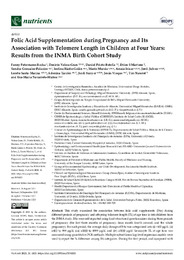
| dc.description.abstract | This study examined the association between folic acid supplements (FAs) during different periods of pregnancy and offspring telomere length (TL) at age four in 666 children from the INMA study. FAs were self-reported using food-structured questionnaires during three periods of pregnancy (the first three months of pregnancy, from month fourth onward, and the whole pregnancy). For each period, the average daily dosage of FAs was categorised into (i) <400 μg/d, (ii) ≥400 to 999 μg/d, (iii) ≥1000 to 4999 μg/d, and (iv) ≥5000 μg/d. Leucocyte TL at age four was measured using quantitative PCR methods. Multiple robust linear log-level regression models were used to report the % difference among FA categories. During the first period, and compared with children whose mothers were classified in the reference group (<400 μg/d), children whose mothers took higher dosages of FAs showed shorter TL at age four (≥5000 μg/d). When the first and the second periods were mutually adjusted, children whose mothers self-reported ≥5000 μg/d during the first period of pregnancy had a statistically significant shorter TL than their counterparts (% difference: -7.28% [95% CI: -14.42 to -0.13]). Similar trends were observed for the whole period of pregnancy. When the analysis was stratified by sex, the association was more evident in boys (% difference: -13.5% [95% CI: -23.0 to -4.04]), whereas no association was observed in girls. This study suggests that high dosages of FAs in the first pregnancy period may be associated with a shorter TL in children at age four, particularly among boys. Further studies should confirm these results. | es_ES |
| dc.format | application/pdf | es_ES |
| dc.format.extent | 14 | es_ES |
| dc.language.iso | eng | es_ES |
| dc.publisher | MDPI | es_ES |
| dc.rights | info:eu-repo/semantics/openAccess | es_ES |
| dc.rights.uri | http://creativecommons.org/licenses/by-nc-nd/4.0/ | * |
| dc.subject | child | es_ES |
| dc.subject | folic acid supplementation | es_ES |
| dc.subject | pregnancy | es_ES |
| dc.subject | telomere length | es_ES |
| dc.title | Folic Acid Supplementation during Pregnancy and Its Association with Telomere Length in Children at Four Years: Results from the INMA Birth Cohort Study | es_ES |
| dc.type | info:eu-repo/semantics/article | es_ES |
| dc.relation.publisherversion | 10.3390/nu15194303 | es_ES |
Ver/Abrir:
Folic Acid Supplementation during Pregnancy and Its.PDF
377,97 kB
Adobe PDF
Compartir:
 La licencia se describe como: Atribución-NonComercial-NoDerivada 4.0 Internacional.