Título :
Evaluation of the use of vineyard pruning biomass (Bobal variety) in constructive bioproducts |
Autor :
Ferrández-Villena, M.
Ferrández-García, Antonio
García-Ortuño, T.
Ferrández-García, M.T. |
Editor :
NC State University |
Departamento:
Departamentos de la UMH::Ingeniería |
Fecha de publicación:
2022 |
URI :
https://hdl.handle.net/11000/38933 |
Resumen :
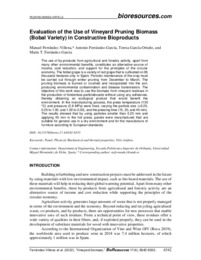
The use of by-products from agricultural and forestry activity, apart from many other environmental benefits, constitutes an alternative source of income, cost reduction, and support for the principles of the circular economy. The bobal grape is a variety of red grape that is cultivated on 65 thousand hectares only in Spain. Periodic maintenance of the crop must be carried out through winter pruning from December to March. The pruning biomass is burned or crushed and incorporated into the soil, producing environmental contamination and disease transmission. The objective of this work was to use the biomass from vineyard residues in the production of binderless particleboards without using any adhesives, thereby obtaining an ecological product that would benefit the environment. In the manufacturing process, the press temperature (130 °C) and pressure (2.6 MPa) were fixed, varying the particle size (<0.25, 0.25 to 1.00, and 1.00 to 2.00), and the pressing time (15, 30, and 45 min). The results showed that by using particles smaller than 0.25 mm and applying 45 min in the hot press, panels were manufactured that are suitable for general use in a dry environment and for the manufacture of furniture according to European standards.
|
Palabras clave/Materias:
Panel
Physical
Mechanical
Thermal properties
Vitis vinifera |
Tipo de documento :
info:eu-repo/semantics/article |
Derechos de acceso:
info:eu-repo/semantics/openAccess
Attribution-NonCommercial-NoDerivatives 4.0 Internacional |
DOI :
DOI: 10.15376/biores.17.4.6542-6555 |
Publicado en:
BioResources 17(4), 6542-6555 |
Aparece en las colecciones:
Artículos - Ingeniería
|
.png)
 La licencia se describe como: Atribución-NonComercial-NoDerivada 4.0 Internacional.