.png)
Por favor, use este identificador para citar o enlazar este ítem:
https://hdl.handle.net/11000/38911Registro completo de metadatos
| Campo DC | Valor | Lengua/Idioma |
|---|---|---|
| dc.contributor.author | Herrero-Brocal, Marta | - |
| dc.contributor.author | Samper Perez, Raquel | - |
| dc.contributor.author | Riquelme, Jorge | - |
| dc.contributor.author | Pineda, Javier | - |
| dc.contributor.author | BORDES SISCAR, PASCUAL | - |
| dc.contributor.author | Torres Mezcua, Fernando José | - |
| dc.contributor.author | Valencia, José | - |
| dc.contributor.author | Torres-Saura, Francisco | - |
| dc.contributor.author | González Manso, María | - |
| dc.contributor.author | Ajo Ferrer, Raquel | - |
| dc.contributor.author | Arenas, Juan | - |
| dc.contributor.author | Feliu, Eloísa | - |
| dc.contributor.author | Martínez, Juan Gabriel | - |
| dc.contributor.author | Ruiz-Nodar, Juan | - |
| dc.contributor.other | Departamentos de la UMH::Patología y Cirugía | es_ES |
| dc.date.accessioned | 2026-01-16T16:06:17Z | - |
| dc.date.available | 2026-01-16T16:06:17Z | - |
| dc.date.created | 2024-10 | - |
| dc.identifier.citation | European Heart Journal - Digital Health, 6(1), 73-81 - November 2024 | es_ES |
| dc.identifier.issn | 2634-3916 | - |
| dc.identifier.uri | https://hdl.handle.net/11000/38911 | - |
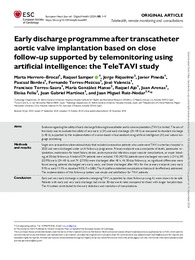
| dc.description.abstract | Aims: Evidence regarding the safety of early discharge following transcatheter aortic valve implantation (TAVI) is limited. The aim of this study was to evaluate the safety of very early (<24) and early discharge (24-48 h) as compared to standard discharge (>48 h), supported by the implementation of a voice-based virtual assistant using artificial intelligence (AI) and natural language processing. Methods and results: Single-arm prospective observational study that included consecutive patients who underwent TAVI in a tertiary hospital in 2023 and were discharged under an AI follow-up programme. Primary endpoint was a composite of death, pacemaker implantation, readmission for heart failure, stroke, acute myocardial infarction, major vascular complications, or major bleeding, at 30-day follow-up. A total of 274 patients were included. 110 (40.1%) patients were discharged very early (<24 h), 90 (32.9%) early (24-48 h), and 74 (27.0%) were discharged after 48 h. At 30-day follow-up, no significant differences were found among patients discharged very early, early, and those discharged after 48 h for the primary endpoint (very early 9.1% vs. early 11.1% vs. standard 9.5%; P = 0.88). The AI platform detected complications that could be effectively addressed. The implementation of this follow-up system was simple and satisfactory for TAVI patients. Conclusion: Early and very early discharge in patients undergoing TAVI, supported by close follow-up using AI, were shown to be safe. Patients with early and very early discharge had similar 30-day event rates compared to those with longer hospital stays. The AI system contributed to the early detection and resolution of complications. | es_ES |
| dc.format | application/pdf | es_ES |
| dc.format.extent | 9 | es_ES |
| dc.language.iso | eng | es_ES |
| dc.publisher | Oxford University Press | es_ES |
| dc.rights | info:eu-repo/semantics/openAccess | es_ES |
| dc.rights | Attribution-NonCommercial-NoDerivatives 4.0 Internacional | * |
| dc.rights.uri | http://creativecommons.org/licenses/by-nc-nd/4.0/ | * |
| dc.subject | Transcatheter aortic valve implantation (TAVI) | es_ES |
| dc.subject | Early discharge | es_ES |
| dc.subject | Artificial intelligence (AI) | es_ES |
| dc.subject | Telemedicine | es_ES |
| dc.subject | Post-discharge monitoring | es_ES |
| dc.subject | Complication detection | es_ES |
| dc.subject.other | CDU::6 - Ciencias aplicadas::61 - Medicina | es_ES |
| dc.title | Early discharge programme after transcatheter aortic valve implantation based on close follow-up supported by telemonitoring using artificial intelligence: the TeleTAVI study | es_ES |
| dc.type | info:eu-repo/semantics/article | es_ES |
| dc.relation.publisherversion | https://doi.org/10.1093/ehjdh/ztae089 | es_ES |
Ver/Abrir:
Early discharge programme after transcatheter aortic valve implantation based on close follow-up supported by telemonitoring using artificial intelligence, the TeleTAVI study.pdf
543,16 kB
Adobe PDF
Compartir:
 La licencia se describe como: Atribución-NonComercial-NoDerivada 4.0 Internacional.