.png)
Por favor, use este identificador para citar o enlazar este ítem:
https://hdl.handle.net/11000/38906Registro completo de metadatos
| Campo DC | Valor | Lengua/Idioma |
|---|---|---|
| dc.contributor.author | gundogdu, evren | - |
| dc.contributor.author | Demir, Emine Selin | - |
| dc.contributor.author | EKİNCİ, MELİHA | - |
| dc.contributor.author | Ozgenc, Emre | - |
| dc.contributor.author | Ilem-Ozdemir, Derya | - |
| dc.contributor.author | Senyigit, Zeynep | - |
| dc.contributor.author | González-Álvarez, Isabel | - |
| dc.contributor.author | Bermejo Sanz, Maria del Val | - |
| dc.contributor.other | Departamentos de la UMH::Ingeniería | es_ES |
| dc.date.accessioned | 2026-01-16T15:37:30Z | - |
| dc.date.available | 2026-01-16T15:37:30Z | - |
| dc.date.created | 2022-01 | - |
| dc.identifier.citation | Nanomaterials (Basel) . 2022 Jan 13;12(2):250 | es_ES |
| dc.identifier.isbn | 2079-4991 | - |
| dc.identifier.uri | https://hdl.handle.net/11000/38906 | - |
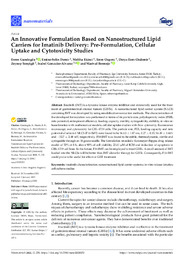
| dc.description.abstract | Imatinib (IMT) is a tyrosine kinase enzyme inhibitor and extensively used for the treatment of gastrointestinal stromal tumors (GISTs). A nanostructured lipid carrier system (NLCS) containing IMT was developed by using emulsification-sonication methods. The characterization of the developed formulation was performed in terms of its particle size, polydispersity index (PDI), zeta potential, entrapment efficiency, loading capacity, sterility, syringeability, stability, in vitro release kinetics with mathematical models, cellular uptake studies with flow cytometry, fluorescence microscopy and cytotoxicity for CRL-1739 cells. The particle size, PDI, loading capacity and zeta potential of selected NLCS (F16-IMT) were found to be 96.63 ± 1.87 nm, 0.27 ± 0.15, 96.49 ± 1.46% and -32.7 ± 2.48 mV, respectively. F16-IMT was found to be stable, thermodynamic, sterile and syringeable through an 18 gauze needle. The formulation revealed a Korsmeyer-Peppas drug release model of 53% at 8 h, above 90% of cell viability, 23.61 µM of IC50 and induction of apoptosis in CRL-1739 cell lines. In the future, F16-IMT can be employed to treat GISTs. A small amount of IMT loaded into the NLCSs will be better than IMT alone for therapy for GISTs. Consequently, F16-IMT could prove to be useful for effective GIST treatment. | es_ES |
| dc.format | application/pdf | es_ES |
| dc.format.extent | 36 | es_ES |
| dc.language.iso | eng | es_ES |
| dc.publisher | MDPI | es_ES |
| dc.rights | info:eu-repo/semantics/openAccess | es_ES |
| dc.rights | Attribution-NonCommercial-NoDerivatives 4.0 Internacional | * |
| dc.rights.uri | http://creativecommons.org/licenses/by-nc-nd/4.0/ | * |
| dc.subject | cell culture studies | es_ES |
| dc.subject | characterization | es_ES |
| dc.subject | imatinib | es_ES |
| dc.subject | in vitro release kinetics | es_ES |
| dc.title | An Innovative Formulation Based on Nanostructured Lipid Carriers for Imatinib Delivery: Pre-Formulation, Cellular Uptake and Cytotoxicity Studies | es_ES |
| dc.type | info:eu-repo/semantics/article | es_ES |
| dc.relation.publisherversion | 10.3390/nano12020250 | es_ES |
Ver/Abrir:
An Innovative Formulation Based on Nanostructured Lipid.pdf
9,61 MB
Adobe PDF
Compartir:
 La licencia se describe como: Atribución-NonComercial-NoDerivada 4.0 Internacional.