.png)
Por favor, use este identificador para citar o enlazar este ítem:
https://hdl.handle.net/11000/38628Registro completo de metadatos
| Campo DC | Valor | Lengua/Idioma |
|---|---|---|
| dc.contributor.author | Nicolás Almansa, María | - |
| dc.contributor.author | Ruiz, David | - |
| dc.contributor.author | Guevara, Alfonso | - |
| dc.contributor.author | Rubio, Manuel | - |
| dc.contributor.author | Martínez Gómez, Pedro | - |
| dc.contributor.author | Brown, Pat J. | - |
| dc.contributor.author | Martínez García, Pedro J. | - |
| dc.contributor.other | Departamentos de la UMH::Biología Aplicada | es_ES |
| dc.date.accessioned | 2025-12-01T10:16:57Z | - |
| dc.date.available | 2025-12-01T10:16:57Z | - |
| dc.date.created | 2025-11 | - |
| dc.identifier.citation | Horticulture Research, uhaf271 Published: 04 November 2025 | es_ES |
| dc.identifier.issn | 2052-7276 | - |
| dc.identifier.uri | https://hdl.handle.net/11000/38628 | - |
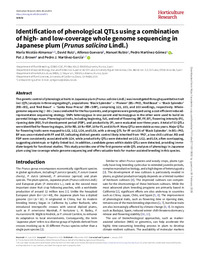
| dc.description.abstract | The genetic control of phenological traits in Japanese plum (Prunus salicina Lindl.) was investigated through quantitative trait loci (QTL) analysis in three segregating F1 populations: ‘Black Splendor’ × ‘Pioneer’ (BS×PIO), ‘Red Beaut’ × ‘Black Splendor’ (RB×BS), and ‘Red Beaut’ × ‘Santa Rosa Precoz’ (RB×SRP), comprising 121, 103, and 103 seedlings, respectively. Whole-genome sequencing (~80×) was conducted for the four parents, and progenies were genotyped using a cost-efficient reduced-representation sequencing strategy. SNPs heterozygous in one parent and homozygous in the other were used to build six parental linkage maps. Phenological traits—including beginning, full, and end of flowering (BF, FF, EF), flowering intensity (FI), ripening date (RD), fruit development period (FDP), and productivity (P)—were evaluated over three years. A total of 53 QTLs were identified for flowering stages, 16 for RD, 18 for FDP, 10 for FI, and 16 for P. Many QTLs were stable across years. Major QTLs for flowering traits were mapped to LG1, LG2, LG4, and LG6, with a strong QTL for FF on LG6 of ‘Black Splendor’. In BS×PIO, BF was uncorrelated with FF and EF, indicating distinct genetic control likely inherited from ‘Pioneer’, a low-chill cultivar. RD and FDP were consistently associated with LG4, while productivity QTLs were detected on LG1, LG2, and LG4, often overlapping, suggesting pleiotropic or tightly linked loci. In addition, candidate genes within stable QTLs were detected, providing immediate targets for functional studies. This study provides one of the first genome-wide QTL analyses of phenology in Japanese plum using low-coverage WGS (lcWGS) and offers valuable tools for marker64 assisted breeding in this species | es_ES |
| dc.format | application/pdf | es_ES |
| dc.format.extent | 39 | es_ES |
| dc.language.iso | eng | es_ES |
| dc.publisher | Prensa de la Universidad de Oxford | es_ES |
| dc.rights | info:eu-repo/semantics/openAccess | es_ES |
| dc.rights | Attribution-NonCommercial-NoDerivatives 4.0 Internacional | * |
| dc.rights.uri | http://creativecommons.org/licenses/by-nc-nd/4.0/ | * |
| dc.subject | Phenology | es_ES |
| dc.subject | Prunus salicina | es_ES |
| dc.subject | breeding | es_ES |
| dc.subject | lcWGS | es_ES |
| dc.title | Identificación de QTL fenológicos utilizando una combinación de secuenciación del genoma completo de alta y baja cobertura en ciruelo japonés ( Prunus salicina Lindl.) | es_ES |
| dc.type | info:eu-repo/semantics/article | es_ES |
| dc.relation.publisherversion | https://doi.org/10.1093/hr/uhaf271 | es_ES |
Ver/Abrir:
Nicolas Almansa et al., 2025.pdf
5,19 MB
Adobe PDF
Compartir:
 La licencia se describe como: Atribución-NonComercial-NoDerivada 4.0 Internacional.