Por favor, use este identificador para citar o enlazar este ítem:
https://hdl.handle.net/11000/40797
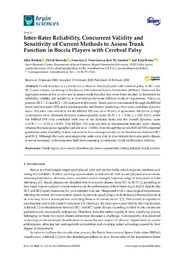
Inter-rater reliability, concurrent validity and sensitivity of current methods to assess trunk function in boccia players with cerebral palsy
Título :
Inter-rater reliability, concurrent validity and sensitivity of current methods to assess trunk function in boccia players with cerebral palsy |
Autor :
Roldán, Alba
Barbado, David
Vera-García, Francisco J.
Sarabia Marín, José Manuel
Reina, Raúl |
Editor :
MDPI |
Departamento:
Departamentos de la UMH::Ciencias del Deporte |
Fecha de publicación:
2020-02-26 |
URI :
https://hdl.handle.net/11000/40797 |
Resumen :
Trunk function is a core factor to allocate Boccia players with cerebral palsy in BC1 and
BC2 sport classes, according to the Boccia International Sports Federation (BISFed). However, the
appropriateness of the current test to assess trunk function has never been studied to determine its
reliability, validity and sensitivity to discriminate between di erent levels of impairment. Thirty-six
players (BC1 = 13 and BC2 = 23) took part in this study. Trunk control was assessed through the BISFed
trunk function scale (TFS) and a posturographic test battery consisting of two static and three dynamic
tasks. The inter-rater reliability for the BISFed TFS was set at 94.44% of agreement. Moderate-to-high
correlations were obtained between posturographic tasks (0.39 < r < 0.96; p < 0.05–0.01), while
the BISFed TFS only correlated with two of the dynamic tasks and the overall dynamic score
(0.38 < r < 0.51; p < 0.05). The BISFed TFS was not able to discriminate between sport classes,
whereas the static posturographic task did so (p=0.004). Even though the current BISFed TFS presented
good inter-rater reliability, it does not seem to have enough sensitivity to discriminate between BC1
and BC2. Although the static posturographic tasks were able to discriminate between sports classes,
it seems necessary to develop new field tests assessing participants’ trunk stabilization abilities.
|
Palabras clave/Materias:
paralympics
para-sport
classification
brain impairment
sitting balance
trunk control |
Área de conocimiento :
CDU: Bellas artes: Diversiones. Espectáculos. Cine. Teatro. Danza. Juegos.Deportes |
Tipo de documento :
info:eu-repo/semantics/article |
Derechos de acceso:
info:eu-repo/semantics/openAccess |
DOI :
https://doi.org/10.3390/brainsci10030130 |
Publicado en:
Brain Science 2020, 10 |
Aparece en las colecciones:
Artículos Ciencias del Deporte
|
 La licencia se describe como: Atribución-NonComercial-NoDerivada 4.0 Internacional.
.png)