.png)
Por favor, use este identificador para citar o enlazar este ítem:
https://hdl.handle.net/11000/39926Registro completo de metadatos
| Campo DC | Valor | Lengua/Idioma |
|---|---|---|
| dc.contributor.author | Nieto Villegas, Roberto | - |
| dc.contributor.author | Brugarolas, Margarita | - |
| dc.contributor.author | Martínez Carrasco, Laura | - |
| dc.contributor.author | Pérez Cueto, Federico J. A. | - |
| dc.contributor.author | Bernabéu, Rodolfo | - |
| dc.contributor.author | Rabadán, Adrián | - |
| dc.contributor.other | Departamentos de la UMH::Economía Agroambiental,Ing. Cartográfica y Expresión Gráfica en la Ingeniería | es_ES |
| dc.date.accessioned | 2026-05-14T11:19:54Z | - |
| dc.date.available | 2026-05-14T11:19:54Z | - |
| dc.date.created | 2026 | - |
| dc.identifier.citation | Agricultural and Food Economics 14, 41 (2026) | es_ES |
| dc.identifier.issn | 2193-7532 | - |
| dc.identifier.uri | https://hdl.handle.net/11000/39926 | - |
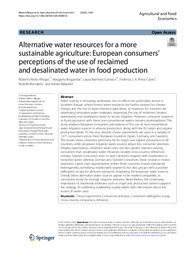
| dc.description.abstract | Water scarcity is increasing worldwide, but its effects are particularly severe in Southern Europe, where limited water resources are further strained by climate change and the rise of water-intensive agriculture. In response, EU countries are developing innovative water strategies, expanding the use of reclaimed (treated wastewater) and desalinated water to secure irrigation. However, consumer response to foods produced with these non-conventional waters remains underexplored. This study analyses European consumers’ perceptions of the use of non-conventional water irrigation sources in almond production, along with the EU origin and organic production labels. To this end, discrete choice experiments are used in a sample of 1,371 consumers across three European countries (Spain, Germany, and Sweden). The results show consistent premiums for EU origin and organic production in all countries, while proposed irrigation water sources attract less consumer attention. Despite expectations, reclaimed water does not face greater rejection among consumers than desalinated water. However, notable cross-country differences emerge: Spanish consumers tend to reject almonds irrigated with desalinated or reclaimed water, whereas German and Swedish consumers show neutral or mixed responses. Latent class segmentation within these countries reveals substantial heterogeneity, identifying traditionalist segments, but also groups with a positive willingness to pay for almonds produced employing the proposed water sources. Overall, these alternative water sources appear to be market-compatible, as consumers reveal no strongly negative attitudes. Nevertheless, the continuing importance of traditional attributes such as origin and production system supports the strategy of combining established quality labels with information about the source of water used. | es_ES |
| dc.format | application/pdf | es_ES |
| dc.format.extent | 19 | es_ES |
| dc.language.iso | eng | es_ES |
| dc.publisher | SpringerOpen | es_ES |
| dc.rights | info:eu-repo/semantics/openAccess | es_ES |
| dc.rights.uri | http://creativecommons.org/licenses/by-nc-nd/4.0/ | * |
| dc.subject | Choice experiment | es_ES |
| dc.subject | Consumers’ attitudes | es_ES |
| dc.subject | Consumers’ willingness to pay | es_ES |
| dc.subject | Cross-country comparison | es_ES |
| dc.subject | Almonds | es_ES |
| dc.subject.other | CDU::6 - Ciencias aplicadas | es_ES |
| dc.title | Alternative water resources for a more sustainable agriculture: European consumers’ perceptions of the use of reclaimed and desalinated water in food production | es_ES |
| dc.type | info:eu-repo/semantics/article | es_ES |
| dc.relation.publisherversion | https://doi.org/10.1186/s40100-026-00485-8 | es_ES |
Ver/Abrir:
Nieto-Villegas_et_al-2026-Agricultural_and_Food_Economics.pdf
1,39 MB
Adobe PDF
Compartir:
 La licencia se describe como: Atribución-NonComercial-NoDerivada 4.0 Internacional.