Título :
Date palm (Phoenix dactylifera) and enriched fresh goat cheese: (poly)phenol profile and stability after INFOGEST 2.0 in vitro digestion method |
Autor :
Lucas González, Raquel
Muñoz Bas, Clara
Muñoz Tebar, Nuria
Pérez Álvarez, José Ángel
Viuda Martos, Manuel
Fernández López, Juana |
Editor :
Elsevier |
Departamento:
Departamentos de la UMH::Tecnología Agroalimentaria |
Fecha de publicación:
2026 |
URI :
https://hdl.handle.net/11000/39559 |
Resumen :
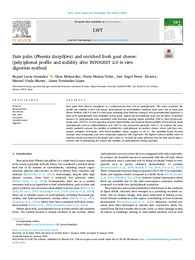
Date palm fruit (Phoenix dactylifera) is a nutrient-dense food rich in (poly)phenols. This study evaluated the
profile and stability of free and bound (poly)phenols in underutilized Confitera fresh dates and in fresh goat
cheese fortified with 4 % and 8 % date paste, including their behavior during in vitro gastrointestinal digestion. A
total of 45 (poly)phenols were identified in date paste, mainly hydroxycinnamic acids and flavonols. In fortified
cheeses, 22 (poly)phenols were quantified, with flavonols showing higher retention (100 %) than hydroxycinnamic acids (54.0 %). In vitro digestion revealed high stability and increased bioaccessibility of several date-paste
(poly)phenols, such as caffeoylshikimic acid (250 %) and chrysoeriol glycoside (160 %). In contrast, the dairy
matrix markedly reduced the stability of soluble-free (poly)phenols in enriched cheese, where only four compounds remained detectable, with bioaccessibility values ranging 11–43 %. The insoluble-bound fraction
retained most compounds, and new compounds appeared after digestion. The highest colon-available index in
enriched cheese was observed for ferulic acid (1000 %). Overall, the study indicated that the food matrix plays a
decisive role in modulating the release and stability, of (poly)phenols during digestion.
|
Palabras clave/Materias:
Bioaccessibility
Microbiome
Date palm
Co-product
Insoluble-bound
Digestion |
Área de conocimiento :
CDU: Ciencias aplicadas |
Tipo de documento :
info:eu-repo/semantics/article |
Derechos de acceso:
info:eu-repo/semantics/openAccess |
DOI :
https://doi.org/10.1016/j.lwt.2026.119019 |
Publicado en:
LWT Volume 240, 15 January 2026, 119019 |
Aparece en las colecciones:
Artículos Tecnología Agroalimentaria
|
.png)
 La licencia se describe como: Atribución-NonComercial-NoDerivada 4.0 Internacional.