.png)
Por favor, use este identificador para citar o enlazar este ítem:
https://hdl.handle.net/11000/39553Registro completo de metadatos
| Campo DC | Valor | Lengua/Idioma |
|---|---|---|
| dc.contributor.author | Lucas González, Raquel | - |
| dc.contributor.author | Albert Bermejo, Alejandra | - |
| dc.contributor.author | Pérez Álvarez, José Ángel | - |
| dc.contributor.author | Fernández López, Juana | - |
| dc.contributor.author | Viuda Martos, Manuel | - |
| dc.contributor.other | Departamentos de la UMH::Tecnología Agroalimentaria | es_ES |
| dc.date.accessioned | 2026-03-17T15:40:40Z | - |
| dc.date.available | 2026-03-17T15:40:40Z | - |
| dc.date.created | 2025-11 | - |
| dc.identifier.citation | Applied Sciences 2025, 15(21), 11795 | es_ES |
| dc.identifier.issn | 2076-3417 | - |
| dc.identifier.uri | https://hdl.handle.net/11000/39553 | - |
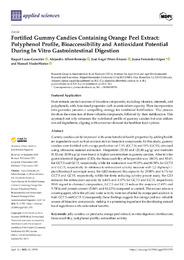
| dc.description.abstract | Gummy candies can be improved with some beneficial health properties by adding healthier ingredients such as fruit extracts rich in bioactive compounds. In this study, gummy candies were fortified with orange peel extract at 7.5% (GC7.5) and 15% (GC15), obtained using ultrasonic-assisted extraction. Hesperidin (53.83 and 122.80 μg/g) and narirutin (9.32 and 20.98 μg/g) were found in higher concentration in gummy candies. After in vitro gastrointestinal digestion (GID), the bioaccessibility of hesperidin was 100.3% and 83.4% for GC7.5 and GC15, respectively, while for narirutin it was 99.15% and 80.58% for GC7.5 and GC15, respectively. In reference to antioxidant activity measure with 2,2-diphenyl-1- picrylhydrazyl scavenger assay, the GID increased this capacity by 29.90% and 6.1% for GC7.5 and GC15, respectively, whilst for ferric reducing activity power assay, the GID reduced the antioxidant capacity by 6.46% and 9.97% for GC7.5 and GC15, respectively. With regard to chemical composition, GC7.5 and GC15 reduce the moisture (2.49% and 5.74%) and protein content (5.84% and 10.23%) compared to control. The extract acts as a coloring agent, while the pH and water activity were not affected by orange peel addition in both GC7.5 and GC15. Consequently, these findings suggest that orange peel is a valuable source of bioactive compounds, making it a promising ingredient for developing natural food ingredients with antioxidant benefits. | es_ES |
| dc.format | application/pdf | es_ES |
| dc.format.extent | 17 | es_ES |
| dc.language.iso | eng | es_ES |
| dc.publisher | MDPI | es_ES |
| dc.rights | info:eu-repo/semantics/openAccess | es_ES |
| dc.rights.uri | http://creativecommons.org/licenses/by-nc-nd/4.0/ | * |
| dc.subject | jelly candies | es_ES |
| dc.subject | co-products | es_ES |
| dc.subject | orange peel extract | es_ES |
| dc.subject | in vitro digestion | es_ES |
| dc.subject | fortification | es_ES |
| dc.subject | bioaccessibility | es_ES |
| dc.subject | polyphenol profi | es_ES |
| dc.subject | antioxidant activity | es_ES |
| dc.title | Fortified Gummy Candies Containing Orange Peel Extract: Polyphenol Profile, Bioaccessibility and Antioxidant Potential During In Vitro Gastrointestinal Digestion | es_ES |
| dc.type | info:eu-repo/semantics/article | es_ES |
| dc.relation.publisherversion | https://doi.org/10.3390/app152111795 | es_ES |
Ver/Abrir:
applsci-15-11795 (1).pdf
721,26 kB
Adobe PDF
Compartir:
 La licencia se describe como: Atribución-NonComercial-NoDerivada 4.0 Internacional.