.png)
Por favor, use este identificador para citar o enlazar este ítem:
https://hdl.handle.net/11000/39529Registro completo de metadatos
| Campo DC | Valor | Lengua/Idioma |
|---|---|---|
| dc.contributor.author | Wanat, Tomasz | - |
| dc.contributor.author | Borusiak, Barbara | - |
| dc.contributor.author | Pieránski, Bartłomiej | - |
| dc.contributor.author | Brugarolas, Margarita | - |
| dc.contributor.author | Martínez-Carrasco, Laura | - |
| dc.contributor.other | Departamentos de la UMH::Economía Agroambiental,Ing. Cartográfica y Expresión Gráfica en la Ingeniería | es_ES |
| dc.date.accessioned | 2026-03-13T16:54:21Z | - |
| dc.date.available | 2026-03-13T16:54:21Z | - |
| dc.date.created | 2025-11 | - |
| dc.identifier.citation | Sustainability, Vol. 18, Issue 2 (2026) | es_ES |
| dc.identifier.issn | 2071-1050 | - |
| dc.identifier.uri | https://hdl.handle.net/11000/39529 | - |
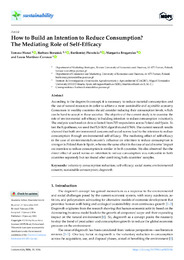
| dc.description.abstract | According to the degrowth concept, it is necessary to reduce material consumption and the use of natural resources in order to achieve a more sustainable and equitable economy. Consumers in wealthy countries should consider reducing their consumption levels, which can be hard to accept in these societies. The objective of the current study is to examine the role of environmental self-efficacy in building intention to reduce consumption voluntarily. The analysis was based on data collected from 705 respondents across Poland and Spain. To test the hypotheses, we used the PLS-SEM algorithm and IPMA. The current research results showed that both environmental concern and social norms lead to the intention to reduce consumption through environmental self-efficacy. The mediating effect of self-efficacy in the case of environmental concern’s influence on intention to reduce consumption is stronger in Poland than in Spain, whereas the same effect in the case of social norms’ impact on intention to reduce consumption is similar in both countries. We also observed that the direct effect of social norms on intention to reduce consumption was noticeable in both countries separately but not found after combining both countries’ samples. | es_ES |
| dc.format | application/pdf | es_ES |
| dc.format.extent | 25 | es_ES |
| dc.language.iso | eng | es_ES |
| dc.publisher | MDPI | es_ES |
| dc.rights | info:eu-repo/semantics/openAccess | es_ES |
| dc.rights.uri | http://creativecommons.org/licenses/by-nc-nd/4.0/ | * |
| dc.subject | voluntary consumption reduction | es_ES |
| dc.subject | self-efficacy | es_ES |
| dc.subject | social norm | es_ES |
| dc.subject | environmental concern | es_ES |
| dc.subject | sustainable consumption | es_ES |
| dc.subject | degrowth | es_ES |
| dc.title | How to Build an Intention to Reduce Consumption? The Mediating Role of Self-Efficacy | es_ES |
| dc.type | info:eu-repo/semantics/article | es_ES |
| dc.relation.publisherversion | https://doi.org/10.3390/su18021016 | es_ES |
Ver/Abrir:
How to build.2026.pdf
1,02 MB
Adobe PDF
Compartir:
 La licencia se describe como: Atribución-NonComercial-NoDerivada 4.0 Internacional.