Please use this identifier to cite or link to this item:
https://hdl.handle.net/11000/38877
Predicting Alzheimer’s disease with practice effects, APOE genotype and brain metabolism
Title:
Predicting Alzheimer’s disease with practice effects, APOE genotype and brain metabolism |
Authors:
Oltra Cucarella, Javier
Sánchez SanSegundo, Miriam
Ferrer Cascales, Rosario |
Editor:
Editorial board |
Department:
Departamentos de la UMH::Psicología de la Salud |
Issue Date:
2022 |
URI:
https://hdl.handle.net/11000/38877 |
Abstract:
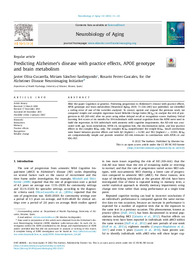
After the paper Cognition or genetics. Predicting progression to Alzheimer’s disease with practice effects, APOE genotype and brain metabolism [Neurobiol Aging, 2018; 71:234–240] was published, we identified a coding error of one of the variables analyzed. To correct, update and expand the previous work, we compared simple and complex regression-based Reliable Change Index (RCI RB ) to analyze the risk of pro- gression to AD (AD-risk) after six years using either delayed recall or recognition scores. Auditory Verbal Learning Test scores at six months for 394 individuals with normal cognition from the ADNI were used to build the regression. In 816 individuals with amnestic mild cognitive impairments, the AD-risk was asso- ciated with age, brain metabolism, APOE- ε4, recognition hits, the discrimination index, and low practice effects in the complex RCI RB only. The complex RCI RB outperformed the simple RCI RB . Small correlations were found between practice effects and both A β(highest r = 0.218) and TAU (highest r = -0.183). RCI RB are computationally simple and provide sensitive AD-risk estimates in combination with APOE- ε4 and FDG-PET.
|
Keywords/Subjects:
biomarkers
memory
practice effects
recognition
reliable change |
Knowledge area:
CDU: Filosofía y psicología: Psicología |
Type of document:
info:eu-repo/semantics/article |
Access rights:
info:eu-repo/semantics/openAccess
Attribution-NonCommercial-NoDerivatives 4.0 Internacional |
DOI:
https://doi.org/10.1016/j.neurobiolaging.2021.12.011 |
Appears in Collections:
Artículos- Psicología de la Salud
|
 ???jsp.display-item.text9???
.png)