Título :
Anthropometrical features of para-footballers according to their cerebral palsy profiles and compared to controls |
Autor :
Sarabia Marín, José Manuel
Doménech, Carmen
Roche, Enrique
Vicente-Salar, Néstor
Reina, Raúl |
Editor :
MDPI |
Departamento:
Departamentos de la UMH::Ciencias del Deporte |
Fecha de publicación:
2020-12-04 |
URI :
https://hdl.handle.net/11000/40798 |
Resumen :
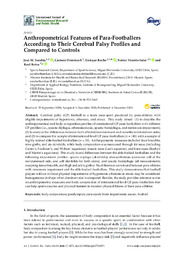
Cerebral palsy (CP) football is a team para-sport practiced by para-athletes with
eligible impairments of hypertonia, athetosis, and ataxia. This study aimed: (1) to describe the
anthropometrical and body composition profiles of international CP para-footballers with di erent
CP profiles (i.e., spastic diplegia, athetosis/ataxia, spastic hemiplegia, and minimum impairment);
(2) to analyze the di erences between both a ected/nondominant and nona ected/dominant sides;
and (3) to compare the sample of international-level CP para-footballers (n = 141) with a sample of
highly trained able-bodied footballers (n = 39). Anthropometric measures included four breadths,
nine girths, and six skinfolds, while body composition was measured through fat mass (including
Carter’s, Faulkner’s, and Withers’ equations), muscle mass (Lee’s equation), and bone mass (Rocha’s
and Martin’s equations). This study found di erences between the able-bodied footballers and the
following impairment profiles: spastic diplegia (skinfolds); ataxia/athetosis (corrected calf of the
nondominant side, and calf skinfolds for both sides); and spastic hemiplegia (all measurements
excepting femur breadth, and thigh and ankle girths). Nodi erences were found between para-athletes
with minimum impairment and the able-bodied footballers. This study demonstrates that football
players with or without physical impairments of hypertonia athetosis or ataxia may be considered
homogeneous in shape when dominant size is compared. Besides, the study provides reference scores
on anthropometric measures and body composition of international-level CP para-footballers that
can help sports coaches and physical trainers to monitor physical fitness of their para-athletes.
|
Palabras clave/Materias:
body composition
paralympics
para-sport
brain impairment
soccer
football |
Área de conocimiento :
CDU: Bellas artes: Diversiones. Espectáculos. Cine. Teatro. Danza. Juegos.Deportes |
Tipo de documento :
info:eu-repo/semantics/article |
Derechos de acceso:
info:eu-repo/semantics/openAccess |
DOI :
https://doi.org/10.3390/ijerph17239071 |
Publicado en:
International Journal of Environmental Research and Public Health 2020, 17 |
Aparece en las colecciones:
Artículos Ciencias del Deporte
|
.png)
 La licencia se describe como: Atribución-NonComercial-NoDerivada 4.0 Internacional.