.png)
Por favor, use este identificador para citar o enlazar este ítem:
https://hdl.handle.net/11000/40348Registro completo de metadatos
| Campo DC | Valor | Lengua/Idioma |
|---|---|---|
| dc.contributor.author | Valls-Chiva, Angeles | - |
| dc.contributor.author | Hornos, Felipe | - |
| dc.contributor.author | Hueso, Jose L. | - |
| dc.contributor.author | Martín-Pardillos, Ana | - |
| dc.contributor.author | Santamaria, Jesus | - |
| dc.contributor.other | Departamentos de la UMH::Agroquímica y Medio Ambiente | es_ES |
| dc.date.accessioned | 2026-09-02T15:40:10Z | - |
| dc.date.available | 2026-09-02T15:40:10Z | - |
| dc.date.created | 2026-07 | - |
| dc.identifier.citation | Journal of Materials Chemistry C, 2026 | es_ES |
| dc.identifier.issn | 2050-7534 | - |
| dc.identifier.issn | 2050-7526 | - |
| dc.identifier.uri | https://hdl.handle.net/11000/40348 | - |
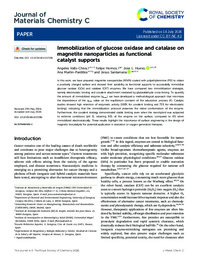
| dc.description.abstract | In this work, we have prepared magnetite nanoparticles (MNPs) coated with polyethylenimine (PEI) to obtain a positively charged surface and showed their suitability as functional supports to successfully immobilize glucose oxidase (GOx) and catalase (CAT) enzymes. We have compared two immobilization strategies, namely electrostatic binding and covalent attachment mediated by glutaraldehyde cross-linking. To quantify the amount of immobilized enzyme (qmax), we have developed a methodological approach that minimizes the dependence of the qmax value on the equilibrium constant of the adsorption process (K). Catalytic studies showed high retention of enzymatic activity (100% for covalent binding and 75% for electrostatic binding), indicating that the immobilization protocol preserves the native conformation of the enzyme. Furthermore, the covalent strategy demonstrated stable binding even when the nanohybrid was subjected to extreme conditions (pH 3), retaining 91% of the enzyme on the surface, compared to 6% when immobilized electrostatically. These results highlight the importance of surface engineering in the design of magnetic biocatalysts for potential application in starvation or oxygen generation therapies. | es_ES |
| dc.format | application/pdf | es_ES |
| dc.format.extent | 14 | es_ES |
| dc.language.iso | eng | es_ES |
| dc.publisher | Royal Society of Chemistry | es_ES |
| dc.rights | info:eu-repo/semantics/openAccess | es_ES |
| dc.rights.uri | http://creativecommons.org/licenses/by-nc-nd/4.0/ | * |
| dc.subject.other | CDU::5 - Ciencias puras y naturales | es_ES |
| dc.title | Immobilization of glucose oxidase and catalase on magnetite nanoparticles as functional catalyst supports | es_ES |
| dc.type | info:eu-repo/semantics/article | es_ES |
| dc.relation.publisherversion | https://doi.org/10.1039/d6tc01728b | es_ES |
Ver/Abrir:
10 - JMCC_2026.pdf
3,06 MB
Adobe PDF
Compartir:
 La licencia se describe como: Atribución-NonComercial-NoDerivada 4.0 Internacional.