.png)
Por favor, use este identificador para citar o enlazar este ítem:
https://hdl.handle.net/11000/40342Registro completo de metadatos
| Campo DC | Valor | Lengua/Idioma |
|---|---|---|
| dc.contributor.author | Garcia-Peiro, Jose I. | - |
| dc.contributor.author | Sancho-Albero, María | - |
| dc.contributor.author | Miguel, Silvia | - |
| dc.contributor.author | Mosseri, Andrea | - |
| dc.contributor.author | Hornos, Felipe | - |
| dc.contributor.author | Contreras-Montoya, Rafael | - |
| dc.contributor.author | Hueso, Jose L. | - |
| dc.contributor.author | Santamaria, Jesus | - |
| dc.contributor.other | Departamentos de la UMH::Agroquímica y Medio Ambiente | es_ES |
| dc.date.accessioned | 2026-09-02T15:33:27Z | - |
| dc.date.available | 2026-09-02T15:33:27Z | - |
| dc.date.created | 2025-07 | - |
| dc.identifier.citation | Advanced Functional Materials, 35(52), e02999, 2025 | es_ES |
| dc.identifier.issn | 1616-3028 | - |
| dc.identifier.issn | 1616-301X | - |
| dc.identifier.uri | https://hdl.handle.net/11000/40342 | - |
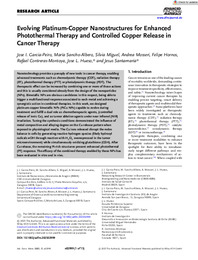
| dc.description.abstract | Nanotechnology provides a panoply of new tools in cancer therapy, enabling advanced treatments such as chemodyamic therapy (CDT), radiation therapy (RT), photothermal therapy (PTT) or photodynamic therapy (PDT). The therapeutic effect can be increased by combining one or more of these actions and this is usually considered already from the design of the nanoparticles (NPs). Bimetallic NPs are obvious candidates in this respect, being able to trigger a multifunctional response associated to each metal and achieving a synergistic action in combined therapies. In this work, we designed platinum-copper bimetallic NPs (PtCu NPs) capable to evolve during treatment and fulfill a dual role as chemotherapeutic agents, (controlled release of ionic Cu), and as tumor ablation agents under near infrared (NIR) irradiation. Tuning the synthesis conditions demonstrated the influence of metal composition and alloying degree on the Cu release pattern when exposed to physiological media. The Cu ions released disrupt the redox balance in cells by generating reactive hydrogen species (likely hydroxyl radicals •OH through reaction with H2O2 overexpressed in the tumor microenvironment) while simultaneously oxidizing glutathione (GSH). After Cu release, the remaining Pt-rich structures present enhanced photothermal (PT) response. The efficacy of the combined therapy enabled by these NPs has been evaluated in vitro and in vivo. | es_ES |
| dc.format | application/pdf | es_ES |
| dc.format.extent | 15 | es_ES |
| dc.language.iso | eng | es_ES |
| dc.publisher | Wiley | es_ES |
| dc.rights | info:eu-repo/semantics/openAccess | es_ES |
| dc.rights | Attribution-NonCommercial-NoDerivatives 4.0 Internacional | * |
| dc.rights.uri | http://creativecommons.org/licenses/by-nc-nd/4.0/ | * |
| dc.subject.other | CDU::5 - Ciencias puras y naturales | es_ES |
| dc.title | Evolving Platinum-Copper Nanostructures for Enhanced Photothermal Therapy and Controlled Copper Release in Cancer Therapy | es_ES |
| dc.type | info:eu-repo/semantics/article | es_ES |
| dc.relation.publisherversion | https://doi.org/10.1002/adfm.202502999 | es_ES |
Ver/Abrir:
3 - Adv Funct Materials_2025.pdf
3 MB
Adobe PDF
Compartir:
 La licencia se describe como: Atribución-NonComercial-NoDerivada 4.0 Internacional.