Título :
Bioethanol fireplaces as indoor pollution sources: The role of burner design and fuel type |
Autor :
Vicente, Estela D.
Cipoli, Yago
Charres, Isabella
Nunes, Teresa
Cerqueira, Mário
Feliciano, Manuel
Galindo, Nuria
Yubero, Eduardo
Alves, Célia
Rysavý, Jirí |
Editor :
Elsevier |
Departamento:
Departamentos de la UMH::Física Aplicada |
Fecha de publicación:
2026 |
URI :
https://hdl.handle.net/11000/39928 |
Resumen :
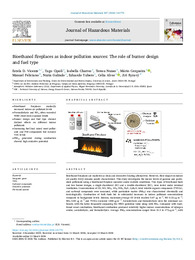
Bioethanol fireplaces are marketed as clean and decorative heating alternatives. However, their impact on indoor
air quality (IAQ) remains poorly characterised. This study investigates the indoor levels of gaseous and particulate
pollutants using a bioethanol fireplace operated under realistic conditions. Two types of bioethanol fuels
and two burner designs, a single-chambered (SC) and a double-chambered (DC), were tested under minimal
ventilation. Concentrations of CO, NO, NO2, CO2, NH3, N2O, C2H6O, total volatile organic compounds (TVOCs),
and carbonyl compounds were measured, while particulate matter (PM10) was characterised chemically and
toxicologically. Combustion of both fuels led to substantial increases in indoor pollutant concentrations
compared to background levels. Indoors, maximum average CO levels reached 5.67 μg m 3, NO 0.33 μg m 3,
NO2 0.85 μg m 3 and TVOCs exceeded 1400 μg m 3. Acetaldehyde and formaldehyde were the dominant carbonyls,
with the latter frequently surpassing the WHO guideline value along with NO2. Compared with traditional
wood combustion, bioethanol combustion produced relatively higher indoor concentrations of nitrogen
oxides, acetaldehyde, and formaldehyde. Average PM10 concentrations ranged from 31.5 to 173 μg m 3, with higher indoor concentrations for the DC burner and Fuel 2. PM10 samples were enriched in bromine, ammonium and nitrate during combustion, and exhibited elevated oxidative potential. Differences in indoor pollutant levels and oxidative potential were observed depending on the burner design, fuel type and initial fuel load. These results demonstrate that flueless bioethanol fireplaces can markedly deteriorate IAQ, underscoring the need for performance standards, improved fuel formulations, and adequate ventilation to mitigate exposure risks asso
ciated with their use.
|
Palabras clave/Materias:
inorganic gases
VOCs
carbonyl compounds
oxidative potential
PM-bound species |
Área de conocimiento :
CDU: Ciencias puras y naturales: Física |
Tipo de documento :
info:eu-repo/semantics/article |
Derechos de acceso:
info:eu-repo/semantics/openAccess
Attribution-NonCommercial-NoDerivatives 4.0 Internacional |
DOI :
https://doi.org/10.1016/j.jhazmat.2026.141770 |
Publicado en:
Journal of Hazardous Materials - Vol. 507 (2026) |
Aparece en las colecciones:
Artículos - Física Aplicada
|
.png)
 La licencia se describe como: Atribución-NonComercial-NoDerivada 4.0 Internacional.