.png)
Por favor, use este identificador para citar o enlazar este ítem:
https://hdl.handle.net/11000/39334Registro completo de metadatos
| Campo DC | Valor | Lengua/Idioma |
|---|---|---|
| dc.contributor.author | Cuadrado-Sempere, Óscar | - |
| dc.contributor.author | Simón-Portillo, Francisco Javier | - |
| dc.contributor.author | Ruzafa-Silvestre, Carlos | - |
| dc.contributor.author | Orgiles-Calpena, Elena | - |
| dc.contributor.author | Arán-Aís, Francisca | - |
| dc.contributor.author | Martins da Silva, Lucas Filipe | - |
| dc.contributor.author | Sánchez-Lozano, Miguel | - |
| dc.contributor.other | Departamentos de la UMH::Ingeniería Mecánica y Energía | es_ES |
| dc.date.accessioned | 2026-02-16T17:49:47Z | - |
| dc.date.available | 2026-02-16T17:49:47Z | - |
| dc.date.created | 2023-07 | - |
| dc.identifier.citation | International Journal of Adhesion and Adhesives, Vol. 138 (2025) | es_ES |
| dc.identifier.issn | 1879-0127 | - |
| dc.identifier.issn | 0143-7496 | - |
| dc.identifier.uri | https://hdl.handle.net/11000/39334 | - |
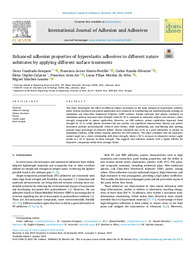
| dc.description.abstract | This study investigates the effect of different surface treatments on the bond strength of hyperelastic adhesive joints. Plasma treatment and primer application were compared to sandblasting and sandblasting plus priming on aluminium and Glass-fibre Reinforced Polyester (GRP) surfaces. Results indicated that plasma treatment on aluminium surfaces increased shear strength values by 20 % compared to untreated surfaces and showed a shear strength comparable to primer application. However, on GRP surfaces, primer application improved bond strength by 10 %, while plasma treatment did not provide any significant enhancement. Plasma and primer treatments produce predominantly cohesive joint failure, while sandblasting and sandblasting plus priming produce large percentage of adhesive failure. Plasma treatment may serve as a good alternative to primer on aluminium surfaces, while primer remains preferred for GRP surfaces. The study concludes that the dispersive contact angle has a direct relationship with shear strength, where a 50 % decrease in dispersive contact angle results in a 10 % increase in shear strength. This suggests that substrate surfaces with a higher affinity for dispersive compounds would form stronger bonds. | es_ES |
| dc.format | application/pdf | es_ES |
| dc.format.extent | 11 | es_ES |
| dc.language.iso | eng | es_ES |
| dc.publisher | Elsevier | es_ES |
| dc.rights | info:eu-repo/semantics/openAccess | es_ES |
| dc.rights | Attribution-NonCommercial-NoDerivatives 4.0 Internacional | * |
| dc.rights.uri | http://creativecommons.org/licenses/by-nc-nd/4.0/ | * |
| dc.subject | adhesive bonding | es_ES |
| dc.subject | surface treatment | es_ES |
| dc.subject | plasma | es_ES |
| dc.subject | contact angle | es_ES |
| dc.subject | bond strength | es_ES |
| dc.subject.other | CDU::6 - Ciencias aplicadas::62 - Ingeniería. Tecnología::621 - Ingeniería mecánica en general. Tecnología nuclear. Electrotecnia. Maquinaria | es_ES |
| dc.title | Enhanced adhesion properties of hyperelastic adhesives to different nature substrates by applying different surface treatments | es_ES |
| dc.type | info:eu-repo/semantics/article | es_ES |
| dc.relation.publisherversion | https://doi.org/10.1016/j.ijadhadh.2025.103934 | es_ES |
Ver/Abrir:
01-Research_IJAA_article_ocuadrado.pdf
6,68 MB
Adobe PDF
Compartir:
 La licencia se describe como: Atribución-NonComercial-NoDerivada 4.0 Internacional.