.png)
Please use this identifier to cite or link to this item:
https://hdl.handle.net/11000/38884Full metadata record
| DC Field | Value | Language |
|---|---|---|
| dc.contributor.author | Peiro, Ana | - |
| dc.contributor.author | Barrachina, Jordi | - |
| dc.contributor.author | Escorial, Mónica | - |
| dc.contributor.author | Aguado, Isidro | - |
| dc.contributor.author | Margarit, César | - |
| dc.contributor.author | Grimby-Ekman, Anna | - |
| dc.contributor.other | Departamentos de la UMH::Farmacología, Pediatría y Química Orgánica | es_ES |
| dc.date.accessioned | 2026-01-15T10:51:45Z | - |
| dc.date.available | 2026-01-15T10:51:45Z | - |
| dc.date.created | 2025-02-11 | - |
| dc.identifier.citation | J Pain Res. 2025 Feb 11:18:673-684 | es_ES |
| dc.identifier.issn | 1178-7090 | - |
| dc.identifier.uri | https://hdl.handle.net/11000/38884 | - |
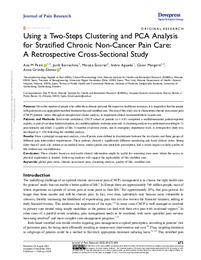
| dc.description.abstract | Purpose: Given the number of people who suffer from chronic pain and the impact on healthcare resources, it is imperative that the people with pain receive an appropriate matched treatment due and stratified care. The aim of this study was to characterize chronic non-cancer pain (CNCP) patients' states, through an unsupervised cluster analysis, to implement clinical recommendations in pain care. Patients and methods: Real-world ambulatory CNCP cohort of patients (n = 418) completed a multidimensional patient-reported registry, as part of a routine initial evaluation, in a multidisciplinary academic pain unit. A clustering analysis was performed according to: 1) pain intensity and relief; 2) quality of life; 3) number of adverse events; and 4) emergency department visits. A retrospective study was developed (n = 120) following the stratified analysis. Results: From a principal component analysis, cut-off points were defined to discriminate between the six clusters and three groups of different pain intervention requirements. Those patients showed a significantly different monitoring and basal clinical status. Being older than 65 years old, retired or on medical leave, under opioids and anxiolytic prescription, had a severe impact on daily quality of life without any sex-difference. Conclusion: These clusters based on real-world clinical information might be useful for screening even more where the access to physical exploration is limited. Follow-up analyses will support the replicability of this stratified care. | es_ES |
| dc.format | application/pdf | es_ES |
| dc.format.extent | 12 | es_ES |
| dc.language.iso | eng | es_ES |
| dc.publisher | DovePress | es_ES |
| dc.rights | info:eu-repo/semantics/openAccess | es_ES |
| dc.rights | Attribution-NonCommercial-NoDerivatives 4.0 Internacional | * |
| dc.rights.uri | http://creativecommons.org/licenses/by-nc-nd/4.0/ | * |
| dc.subject | chronic non-cancer pain | es_ES |
| dc.subject | clustering analysis | es_ES |
| dc.subject | global pain status | es_ES |
| dc.subject | quality of life | es_ES |
| dc.subject | stratified care | es_ES |
| dc.title | Using a Two-Steps Clustering and PCA Analysis for Stratified Chronic Non-Cancer Pain Care: A Retrospective Cross-Sectional Study | es_ES |
| dc.type | info:eu-repo/semantics/article | es_ES |
| dc.relation.publisherversion | 10.2147/JPR.S490442 | es_ES |
View/Open:
Using a Two-Steps Clustering and PCA Analysis.pdf
2,36 MB
Adobe PDF
Share:
