Por favor, use este identificador para citar o enlazar este ítem:
https://hdl.handle.net/11000/38614
Estimating production functions through additive models based on regression splines
Título :
Estimating production functions through additive models based on regression splines |
Autor :
España Roch, Víctor Javier
Aparicio, Juan
Barber i Vallés, Josep Xavier
Esteve, Miriam |
Editor :
Elsevier |
Departamento:
Departamentos de la UMH::Estadística, Matemáticas e Informática |
Fecha de publicación:
2024 |
URI :
https://hdl.handle.net/11000/38614 |
Resumen :
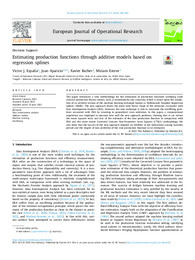
This paper introduces a new methodology for the estimation of production functions satisfying some classical production theory axioms, such as monotonicity and concavity, which is based upon the adaptation of an additive version of the machine learning technique known as Multivariate Adaptive Regression Splines (MARS). The new approach shares the piece-wise linear shape of the estimator associated with Data Envelopment Analysis (DEA). However, the new technique is able to surmount the overfitting problems associated with DEA by resorting to generalized cross-validation. In this paper, a computational experience was employed to measure how well the new approach performs, showing that it can reduce the mean squared error and bias of the estimator of the true production function in comparison with DEA and the more recent Corrected Concave Non-Parametric Least Squares (C2NLS) methodology. We also show that the success of the new approach depends on whether or not interactions among variables prevail and the degree of non-additivity of the true production function to be estimated.
|
Palabras clave/Materias:
data envelopment analysis
additive models
machine learning
overfitting |
Área de conocimiento :
CDU: Ciencias sociales: Demografía. Sociología. Estadística: Estadística
CDU: Ciencias puras y naturales: Matemáticas: Análisis |
Tipo de documento :
info:eu-repo/semantics/article |
Derechos de acceso:
info:eu-repo/semantics/openAccess
Attribution-NonCommercial-NoDerivatives 4.0 Internacional |
DOI :
https://doi.org/10.1016/j.ejor.2023.06.035 |
Publicado en:
European Journal of Operational Research (EJOR) |
Aparece en las colecciones:
Artículos - Estadística, Matemáticas e Informática
|
 La licencia se describe como: Atribución-NonComercial-NoDerivada 4.0 Internacional.
.png)