.png)
Please use this identifier to cite or link to this item:
https://hdl.handle.net/11000/38568Full metadata record
| DC Field | Value | Language |
|---|---|---|
| dc.contributor.author | Arance-Gil, Ángeles | - |
| dc.contributor.author | Villa-Collar, César | - |
| dc.contributor.author | Pérez-Sanchez, Belén | - |
| dc.contributor.author | Carracedo, Gonzalo | - |
| dc.contributor.author | Gutiérrez-Ortega, Ramón | - |
| dc.contributor.other | Departamentos de la UMH::Estadística, Matemáticas e Informática | es_ES |
| dc.date.accessioned | 2025-11-28T08:49:50Z | - |
| dc.date.available | 2025-11-28T08:49:50Z | - |
| dc.date.created | 2021 | - |
| dc.identifier.citation | Journal of Optometry, Volume 14, Issue 2, April–June 2021, Pages 189-198 | es_ES |
| dc.identifier.issn | 1989-1342 | - |
| dc.identifier.issn | 1888-4296 | - |
| dc.identifier.uri | https://hdl.handle.net/11000/38568 | - |
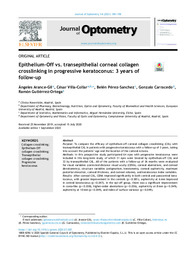
| dc.description.abstract | Purpose: To compare the efficacy of epithelium-off corneal collagen crosslinking (CXL) with transepithelial CXL in patients with progressive keratoconus with a follow-up of 3 years, taking into account the patients’ age and the location of the corneal ectasia. Methods: In this prospective study participated 64 eyes with progressive keratoconus were included in this long-term study, of which 31 eyes were treated by epithelium-off CXL and 33 by transepithelial CXL. All of the patients with a follow-up of 36 months were evaluated for visual variables (corrected distance visual acuity (CDVA), corneal aberrations, and corneal densitometry), structure variables (astigmatism, keratometry, corneal asphericity, maximum posterior elevation, corneal thickness, and corneal volume), and keratoconus index variables. Results: After corneal CXL, CDVA improved significantly in both central and paracentral keratoconus, with greater improvement in the centrals (p = 0.001), asphericity at 6 mm improved in central keratoconus (p = 0.047). In the epi-off group, there was a significant improvement in coma-like (p = 0.038), higher-order aberrations (p = 0.036), asphericity at 8 mm (p = 0.049), asphericity at 10 mm (p = 0.049), and index of surface variance (p = 0.049). Conclusion: Although both techniques halted and stabilized the progression of keratoconus, epithelium-off CXL was more effective. In addition, after the corneal CXL, there was a greater degree of regularization of the corneal surface and, therefore, a greater improvement in the CDVA with central keratoconus than with paracentral keratoconus. © 2020 Spanish General Council of Optometry. Published by Elsevier Espana, ˜ S.L.U. This is an open access article under the CC BY-NC-ND license (http://creativecommons.org/licenses/bync-nd/4.0/). | es_ES |
| dc.format | application/pdf | es_ES |
| dc.format.extent | 10 | es_ES |
| dc.language.iso | eng | es_ES |
| dc.publisher | Elsevier | es_ES |
| dc.rights | info:eu-repo/semantics/openAccess | es_ES |
| dc.rights | Attribution-NonCommercial-NoDerivatives 4.0 Internacional | * |
| dc.rights.uri | http://creativecommons.org/licenses/by-nc-nd/4.0/ | * |
| dc.subject | Collagen crosslinking | es_ES |
| dc.subject | Epithelium-Off | es_ES |
| dc.subject | collagen crosslinking | es_ES |
| dc.subject | Transepithelial collagen crosslinking | es_ES |
| dc.subject | Progressive keratoconus | es_ES |
| dc.subject.other | CDU::0 - Generalidades. | es_ES |
| dc.title | Epithelium-Off vs. transepithelial corneal collagen crosslinking in progressive keratoconus: 3 years of follow-up | es_ES |
| dc.type | info:eu-repo/semantics/article | es_ES |
| dc.relation.publisherversion | https://doi.org/10.1016/j.optom.2020.07.005 | es_ES |
View/Open:
1-s2.0-S188842962030087X-main.pdf
709,94 kB
Adobe PDF
Share:
