.png)
Por favor, use este identificador para citar o enlazar este ítem:
https://hdl.handle.net/11000/40718Registro completo de metadatos
| Campo DC | Valor | Lengua/Idioma |
|---|---|---|
| dc.contributor.author | Cabello García, Esteban | - |
| dc.contributor.author | Gonçalves Dosantos, Juan Carlos | - |
| dc.contributor.author | Morales, Domingo | - |
| dc.contributor.author | Sánchez Soriano, Joaquín | - |
| dc.contributor.other | Departamentos de la UMH::Estadística, Matemáticas e Informática | es_ES |
| dc.date.accessioned | 2026-09-18T07:29:08Z | - |
| dc.date.available | 2026-09-18T07:29:08Z | - |
| dc.date.created | 2026 | - |
| dc.identifier.citation | TEST | es_ES |
| dc.identifier.issn | 1133-0686 | - |
| dc.identifier.issn | 1863-8260 | - |
| dc.identifier.uri | https://hdl.handle.net/11000/40718 | - |
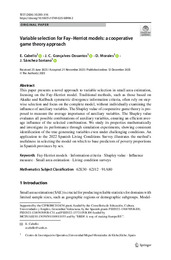
| dc.description.abstract | This paper presents a novel approach to variable selection in small area estimation, focusing on the Fay–Herriot model. Traditional methods, such as those based on Akaike and Kullback symmetric divergence information criteria, often rely on stepwise selection and focus on the complete model, without individually examining the influence of auxiliary variables. The Shapley value of cooperative game theory is proposed to measure the average importance of auxiliary variables. The Shapley value evaluates all possible combinations of auxiliary variables, ensuring an efficient average influence of the selected combination. We study its properties mathematically and investigate its performance through simulation experiments, showing consistent identification of the true generating variables even under challenging conditions. An application to the 2022 Spanish Living Conditions Survey illustrates the method’s usefulness in selecting the model on which to base predictors of poverty proportions in Spanish provinces by sex. | es_ES |
| dc.format | application/pdf | es_ES |
| dc.format.extent | 32 | es_ES |
| dc.language.iso | eng | es_ES |
| dc.publisher | Springer | es_ES |
| dc.relation.ispartofseries | Vol. 35 | es_ES |
| dc.rights | info:eu-repo/semantics/openAccess | es_ES |
| dc.rights | Attribution-NonCommercial-NoDerivatives 4.0 Internacional | * |
| dc.rights.uri | http://creativecommons.org/licenses/by-nc-nd/4.0/ | * |
| dc.subject | Fay-Herriot models | es_ES |
| dc.subject | information criteria | es_ES |
| dc.subject | Shapley value | es_ES |
| dc.subject | influence measure | es_ES |
| dc.subject | small area estimation | es_ES |
| dc.subject | living condition surveys | es_ES |
| dc.subject.other | CDU::5 - Ciencias puras y naturales::51 - Matemáticas | es_ES |
| dc.subject.other | CDU::3 - Ciencias sociales::31 - Demografía. Sociología. Estadística::311 - Estadística | es_ES |
| dc.subject.other | CDU::3 - Ciencias sociales::33 - Economía | es_ES |
| dc.title | Variable selection for Fay–Herriot models: a cooperative game theory approach | es_ES |
| dc.type | info:eu-repo/semantics/article | es_ES |
| dc.relation.publisherversion | https://doi.org/10.1007/s11749-025-00998-2 | es_ES |
Ver/Abrir:
TEST_2026.pdf
1,59 MB
Adobe PDF
Compartir:
 La licencia se describe como: Atribución-NonComercial-NoDerivada 4.0 Internacional.