.png)
Por favor, use este identificador para citar o enlazar este ítem:
https://hdl.handle.net/11000/40481Registro completo de metadatos
| Campo DC | Valor | Lengua/Idioma |
|---|---|---|
| dc.contributor.author | Lloret-Irles, Daniel | - |
| dc.contributor.author | Cabrera-Perona, Víctor | - |
| dc.contributor.other | Departamentos de la UMH::Psicología de la Salud | es_ES |
| dc.date.accessioned | 2026-09-07T18:15:43Z | - |
| dc.date.available | 2026-09-07T18:15:43Z | - |
| dc.date.created | 2026 | - |
| dc.identifier.citation | Journal of Gambling Studies - (2026) | es_ES |
| dc.identifier.issn | 1573-3602 | - |
| dc.identifier.issn | 1050-5350 | - |
| dc.identifier.uri | https://hdl.handle.net/11000/40481 | - |
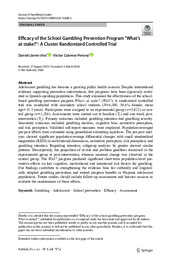
| dc.description.abstract | Adolescent gambling has become a growing public health concern. Despite international evidence supporting preventive interventions, few programs have been rigorously evaluated in Spanish-speaking populations. This study examined the effectiveness of the schoolbased gambling prevention program What’s at stake? (WAS?). A randomized controlled trial was conducted with secondary school students (N = 6,308; 50.6% female; mean age = 15.3 years). Participants were assigned to an experimental group (n = 5,022) or control group (n = 1,286). Assessments were carried out at baseline (T1) and one week postintervention (T2). Primary outcomes included gambling intention and gambling severity. Secondary outcomes included gambling motives, cognitive bias, normative perception, and risk perception. Validated self-report measures were employed. Population-averaged pre-post effects were estimated using generalized estimating equations. The pre-post analyses showed significant population-average differential changes with small standardized magnitudes (RESI) in motivational dimensions, normative perception, risk perception, and gambling intention. Regarding intention, subgroup analyses by gender showed similar patterns. Descriptively, the proportion of at-risk and problem gamblers decreased in the experimental group at post-intervention, whereas minimal change was observed in the control group. The WAS? program produced significant short-term population-level preventive effects on key cognitive, motivational and intentional risk factors for gambling. Our findings contribute to strengthening the evidence base for culturally and linguistically adapted gambling prevention and extend program benefits in Hispanic adolescent populations. Future studies should include follow-up assessments and booster sessions to evaluate the maintenance of these effects. | es_ES |
| dc.format | application/pdf | es_ES |
| dc.format.extent | 17 | es_ES |
| dc.language.iso | eng | es_ES |
| dc.publisher | Springer | es_ES |
| dc.rights | info:eu-repo/semantics/openAccess | es_ES |
| dc.rights | Attribution-NonCommercial-NoDerivatives 4.0 Internacional | * |
| dc.rights.uri | http://creativecommons.org/licenses/by-nc-nd/4.0/ | * |
| dc.subject | gambling | es_ES |
| dc.subject | adolescent | es_ES |
| dc.subject | school prevention | es_ES |
| dc.subject | efficacy | es_ES |
| dc.subject | assessment | es_ES |
| dc.subject.other | CDU::1 - Filosofía y psicología::159.9 - Psicología | es_ES |
| dc.title | Efficacy of the School Gambling Prevention Program “What’s at stake?”: A Cluster Randomized Controlled Trial | es_ES |
| dc.type | info:eu-repo/semantics/article | es_ES |
| dc.relation.publisherversion | https://doi.org/10.1007/s10899-026-10486-3 | es_ES |
Ver/Abrir:
20-2026-LLORET-CABRERA-PERONA-ARTICULO-JOGS-QUE-TE-JUEGAS.pdf
1,21 MB
Adobe PDF
Compartir:
 La licencia se describe como: Atribución-NonComercial-NoDerivada 4.0 Internacional.