Por favor, use este identificador para citar o enlazar este ítem:
https://hdl.handle.net/11000/40049
Evaluating implementation fidelity in traditional vs. computerized formats of Super Skills for Life program
Título :
Evaluating implementation fidelity in traditional vs. computerized formats of Super Skills for Life program |
Autor :
Galán-Luque, Teresa
Orgilés, Mireia |
Editor :
Elsevier |
Departamento:
Departamentos de la UMH::Psicología de la Salud |
Fecha de publicación:
2025 |
URI :
https://hdl.handle.net/11000/40049 |
Resumen :
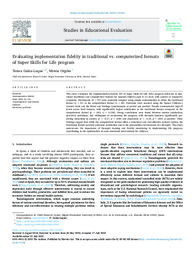
This study evaluated the implementation fidelity (IF) of Super Skills for Life (SSL) program delivered in individual
traditional and computerized formats for Spanish children aged 8–12 years with anxiety or depressive
symptoms. Participants (N = 97) were randomly assigned using simple randomization to either the traditional
format (n = 51) or the computerized format (n = 46). Outcomes were assessed using the Spence Children’s
Anxiety Scale and the Mood and Feelings Questionnaire at pretest and posttest. Results demonstrated high IF
levels across both formats, with significantly higher satisfaction in the traditional format compared to the
computerized format (p = .043, rb = 0.236). Strong correlations were found between session satisfaction,
perceived usefulness, and willingness to recommend the program, with therapist kindness significantly predicting
reductions in anxiety (β = –0.17, p = .039) and depression (β = –0.24, p = .005) at posttest. These
findings suggest that while the computerized format offers a structured and cost-effective delivery option, the
traditional format provides enhanced satisfaction due to the personalized involvement of a therapist. This study
underscores the importance of therapist training and fidelity monitoring in implementing SSL program,
contributing to the optimization of socio-emotional interventions for children.
|
Palabras clave/Materias:
implementation fidelity
super skills for life
transdiagnostic intervention
children
emotional problems |
Área de conocimiento :
CDU: Filosofía y psicología: Psicología |
Tipo de documento :
info:eu-repo/semantics/article |
Derechos de acceso:
info:eu-repo/semantics/openAccess
Attribution-NonCommercial-NoDerivatives 4.0 Internacional |
DOI :
https://doi.org/10.1016/j.stueduc.2025.101493 |
Publicado en:
Studies in Educational Evaluation - Vol. 86 (2025) |
Aparece en las colecciones:
Artículos- Psicología de la Salud
|
 La licencia se describe como: Atribución-NonComercial-NoDerivada 4.0 Internacional.
.png)