Please use this identifier to cite or link to this item:
https://hdl.handle.net/11000/39585
Brain Permeable SGK1 Inhibitors: A Promising Therapeutic Strategy for Neurodegenerative Diseases
 View/Open: SGK1.pdf
6,22 MB
Adobe PDF
Share:
Title:
Brain Permeable SGK1 Inhibitors: A Promising Therapeutic Strategy for Neurodegenerative Diseases |
Authors:
Madruga, Enrique
García-Rubia, Alfonso
Sánchez-Núñez, Carlos
Martínez-González, Loreto
Fernández-Escamilla, Ana María
Lastres-Becker, Isabel
Gil, Carmen
Martínez, Ana |
Editor:
American Chemical Society |
Department:
Departamentos de la UMH::Bioquímica y Biología Molecular |
Issue Date:
2025-10 |
URI:
https://hdl.handle.net/11000/39585 |
Abstract:
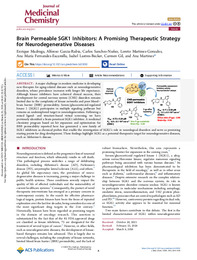
A major challenge in modern medicine is developing
new therapies for aging-related diseases such as neurodegenerative
disorders, whose prevalence increases with longer life expectancy.
Although kinase inhibitors have achieved clinical success, their
development for central nervous system (CNS) disorders remains
limited due to the complexity of kinase networks and poor blood−
brain barrier (BBB) permeability. Serum/glucocorticoid-regulated
kinase 1 (SGK1) participates in multiple signaling pathways but
remains an underexplored target in neurodegeneration. Following a
mixed ligand- and structure-based virtual screening, we have
previously identified a brain-penetrant SGK1 inhibitor. A medicinal
chemistry program based on hit expansion and optimization for
BBB permeability reported here has generated a new family of
SGK1 inhibitors as chemical probes that enable the investigation of SGK1’s role in neurological disorders and serve as promising
starting points for drug development. These findings highlight SGK1 as a potential therapeutic target for neurodegenerative diseases,
such as Alzheimer’s disease.
|
Keywords/Subjects:
SGK1
neurodegeneration
kinase inhibitors
neurodegenerative diseases |
Knowledge area:
CDU: Ciencias puras y naturales: Biología: Bioquímica. Biología molecular. Biofísica |
Type of document:
info:eu-repo/semantics/article |
Access rights:
info:eu-repo/semantics/openAccess
Attribution-NonCommercial-NoDerivatives 4.0 Internacional |
DOI:
https://doi.org/10.1021/acs.jmedchem.5c03050 |
Published in:
Journal of Medicinal Chemistry - (ASAP) (2026) |
Appears in Collections:
Artículos - Bioquímica y Biología Molecular
|
 ???jsp.display-item.text9???
.png)