Por favor, use este identificador para citar o enlazar este ítem:
https://hdl.handle.net/11000/39003
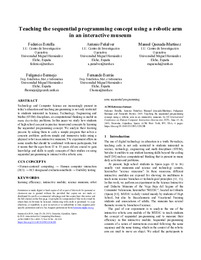
Teaching the sequential programming concept using a robotic arm in an interactive museum
Título :
Teaching the sequential programming concept using a robotic arm in an interactive museum |
Autor :
Botella, Federico
Peñalver, Antonio
Quesada-Martínez, Manuel
Bermejo, Fulgencio
Borrás, Fernando |
Editor :
Association for Computing Machinery |
Departamento:
Departamentos de la UMH::Estadística, Matemáticas e Informática |
Fecha de publicación:
2019 |
URI :
https://hdl.handle.net/11000/39003 |
Resumen :
Technology and Computer Science are increasingly present in
today's education and teaching programming is not only restricted
to students interested in Science, Technology, Engineering and
Maths (STEM) disciplines, as computational thinking is useful in
many day-to-day problems. In this paper we study how students
of high school can put in practice transversal concepts by learning
the sequential programming concept. We analyze their learning
process by asking them to code a simple program that solves a
concrete problem: perform simple and immersive tasks using a
physical robot in an interactive museum. The experiment offers us
some results that should be confirmed with more participants, but
it seems that the ages from 13 to 15 years old are crucial to gain
knowledge and skills to apply concepts of their studies on using
sequential programming to interact with a robotic arm.
|
Palabras clave/Materias:
Learning efficiency
Interactive module
Science museum
Robot |
Tipo de documento :
info:eu-repo/semantics/conferenceObject |
Derechos de acceso:
info:eu-repo/semantics/openAccess
Attribution-NonCommercial-NoDerivatives 4.0 Internacional |
DOI :
https://doi.org/10.1145/3335595.3336289 |
Publicado en:
Proceedings of the XX International Conference on Human-Computer Interaction - INTERACCIÓN 2019, Nº 32 (2019) |
Aparece en las colecciones:
Ponencias y comunicaciones - Estadística, Matemáticas e Informática
|
 La licencia se describe como: Atribución-NonComercial-NoDerivada 4.0 Internacional.
.png)