.png)
Por favor, use este identificador para citar o enlazar este ítem:
https://hdl.handle.net/11000/38876Registro completo de metadatos
| Campo DC | Valor | Lengua/Idioma |
|---|---|---|
| dc.contributor.author | Martínez Horta, Saul | - |
| dc.contributor.author | Pérez Pérez, Jesús | - |
| dc.contributor.author | Oltra Cucarella, Javier | - |
| dc.contributor.author | Sampedro, Frederic | - |
| dc.contributor.author | Horta Barba, Andrea | - |
| dc.contributor.author | Puig Davi, Arnau | - |
| dc.contributor.author | Pagonabarraga, Javier | - |
| dc.contributor.author | Kulisevsky, Jaime | - |
| dc.contributor.other | Departamentos de la UMH::Psicología de la Salud | es_ES |
| dc.date.accessioned | 2026-01-14T10:50:26Z | - |
| dc.date.available | 2026-01-14T10:50:26Z | - |
| dc.date.created | 2023 | - |
| dc.identifier.citation | European Journal of Neurology | es_ES |
| dc.identifier.issn | 1468-1331 | - |
| dc.identifier.issn | 1351-5101 | - |
| dc.identifier.uri | https://hdl.handle.net/11000/38876 | - |
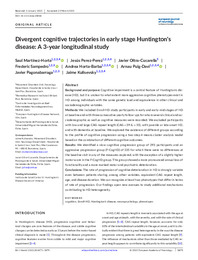
| dc.description.abstract | Background and purpose: Cognitive impairment is a central feature of Huntington's disease (HD), but it is unclear to what extent more aggressive cognitive phenotypes exist in HD among individuals with the same genetic load and equivalence in other clinical and sociodemographic variables. Methods: We included Enroll-HD study participants in early and early-mid stages of HD at baseline and with three consecutive yearly follow-ups for whom several clinical and sociodemographic as well as cognitive measures were recorded. We excluded participants with low and large CAG repeat length (CAG < 39 & > 55), with juvenile or late onset HD, and with dementia at baseline. We explored the existence of different groups according to the profile of cognitive progression using a two-step k-means cluster analysis model based on the combination of different cognitive outcomes. Results: We identified a slow cognitive progression group of 293 participants and an aggressive progression group (F-CogHD) of 235 for which there were no differences at the baseline visit in any of the measures explored, with the exception of a slightly higher motor score in the F-CogHD group. This group showed a more pronounced annual loss of functionality and a more marked motor and psychiatric deterioration. Conclusions: The rate of progression of cognitive deterioration in HD is strongly variable even between patients sharing, among other variables, equivalent CAG repeat length, age, and disease duration. We can recognize at least two phenotypes that differ in terms of rate of progression. Our findings open new avenues to study additional mechanisms contributing to HD heterogeneity | es_ES |
| dc.format | application/pdf | es_ES |
| dc.format.extent | 9 | es_ES |
| dc.language.iso | eng | es_ES |
| dc.publisher | Wiley y la Academia Europea de Neurología | es_ES |
| dc.relation.ispartofseries | 30(7) | es_ES |
| dc.relation.ispartofseries | 1871-1879 | es_ES |
| dc.rights | info:eu-repo/semantics/openAccess | es_ES |
| dc.rights | Attribution-NonCommercial-NoDerivatives 4.0 Internacional | * |
| dc.rights.uri | http://creativecommons.org/licenses/by-nc-nd/4.0/ | * |
| dc.subject | cognition | es_ES |
| dc.subject | enroll-HD | es_ES |
| dc.subject | huntington's disease | es_ES |
| dc.subject | neuropsychology | es_ES |
| dc.subject | phenotypes | es_ES |
| dc.subject.other | CDU::1 - Filosofía y psicología::159.9 - Psicología | es_ES |
| dc.title | Divergent cognitive trajectories in early stage Huntington's disease: A 3-year longitudinal study | es_ES |
| dc.title.alternative | Trayectorias cognitivas divergentes en la enfermedad de Huntington en etapa temprana: un estudio longitudinal de tres años | es_ES |
| dc.type | info:eu-repo/semantics/article | es_ES |
| dc.relation.publisherversion | 10.1111/ene.15806 | es_ES |
Ver/Abrir:
Martínez-Horta et al. - 2023 - Divergent cognitive trajectories in early stage Hu.pdf
580,58 kB
Adobe PDF
Compartir:
 La licencia se describe como: Atribución-NonComercial-NoDerivada 4.0 Internacional.