.png)
Por favor, use este identificador para citar o enlazar este ítem:
https://hdl.handle.net/11000/38830Registro completo de metadatos
| Campo DC | Valor | Lengua/Idioma |
|---|---|---|
| dc.contributor.author | Nicolás, J. F. | - |
| dc.contributor.author | Crespo, J. | - |
| dc.contributor.author | Yubero, E. | - |
| dc.contributor.author | Alfosea-Simón, M. | - |
| dc.contributor.author | Clemente, A. | - |
| dc.contributor.author | Gómez-Sánchez, N. | - |
| dc.contributor.other | Departamentos de la UMH::Física Aplicada | es_ES |
| dc.date.accessioned | 2025-12-22T11:06:30Z | - |
| dc.date.available | 2025-12-22T11:06:30Z | - |
| dc.date.created | 2026-01 | - |
| dc.identifier.citation | Journal of Atmospheric and Solar-Terrestrial Physics, Vol. 278 (2026) | es_ES |
| dc.identifier.issn | 1879-1824 | - |
| dc.identifier.issn | 1364-6826 | - |
| dc.identifier.uri | https://hdl.handle.net/11000/38830 | - |
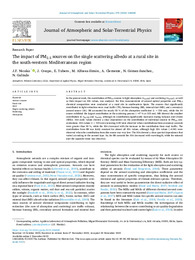
| dc.description.abstract | In the present work, the contribution of PM2.5 sources to light absorption (σap,520) and scattering (σsp,525), as well as their impact on SSA values, was analysed. For this, measurements of aerosol optical properties and PM2.5 chemical composition were conducted at a rural site in southeastern Spain. The sources that significantly contributed to light extinction were: road traffic (TR), biomass burning (BB), mineral dust (MD), and a secondary aerosol source (SA). BB accounted for nearly 50 % of the absorption coefficient (λ = 520 nm), while the SA source exhibited the largest contribution to the scattering process (~47 % at 525 nm). MD showed the smallest contribution to σap,520 and σsp,525, although its contribution significantly increased during Saharan dust events (SDEs). SSA daily values showed a clear dependence on the contribution of individual sources to PM2.5 concentrations. SSA values (λ = 525 nm) exceeding 0.90 were observed when contributions from secondary aerosols were greater than 50 %, while the SSA decreased with the increase in the contribution from road traffic. The contribution from BB was fairly constant for almost all SSA values, although high SSA values (>0.90) were observed when the contribution from this source was very low. The SSA showed a clear spectral dependence that varied according to the aerosol type. So, for BB aerosols the SSA decreased with wavelength, while for mineral dust the opposite trend was observed. | es_ES |
| dc.format | application/pdf | es_ES |
| dc.language.iso | eng | es_ES |
| dc.publisher | Elsevier | es_ES |
| dc.rights | info:eu-repo/semantics/openAccess | es_ES |
| dc.rights | Attribution-NonCommercial-NoDerivatives 4.0 Internacional | * |
| dc.rights.uri | http://creativecommons.org/licenses/by-nc-nd/4.0/ | * |
| dc.subject | Aerosol sources | es_ES |
| dc.subject | Rural site | es_ES |
| dc.subject | MLR | es_ES |
| dc.subject | Single scattering albedo | es_ES |
| dc.subject | Scattering | es_ES |
| dc.subject | Absorption | es_ES |
| dc.title | The impact of PM2.5 sources on the single scattering albedo at a rural site in the south-western Mediterranean region | es_ES |
| dc.type | info:eu-repo/semantics/article | es_ES |
| dc.relation.publisherversion | https://doi.org/10.1016/j.jastp.2025.106698 | es_ES |
Ver/Abrir:
Nicolás et al. 2026_J. Atmos. Solar Terrestrial Phys.pdf
1,52 MB
Adobe PDF
Compartir:
 La licencia se describe como: Atribución-NonComercial-NoDerivada 4.0 Internacional.