Please use this identifier to cite or link to this item:
https://hdl.handle.net/11000/38787
Brain mesenchymal stem cells: physiology and pathological implications
Title:
Brain mesenchymal stem cells: physiology and pathological implications |
Authors:
Pombero, Ana
Garcia-López, Raquel
Martínez, Salvador |
Editor:
The Japanese Society of Developmental Biologists |
Department:
Departamentos de la UMH::Histología y Anatomía |
Issue Date:
2016-06 |
URI:
https://hdl.handle.net/11000/38787 |
Abstract:
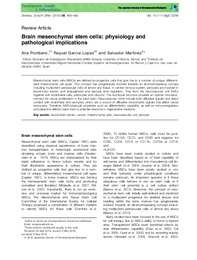
Mesenchymal stem cells (MSCs) are defined as progenitor cells that give rise to a number of unique, differentiated mesenchymal cell types. This concept has progressively evolved towards an all-encompassing concept including multipotent perivascular cells of almost any tissue. In central nervous system, pericytes are involved in blood-brain barrier, and angiogenesis and vascular tone regulation. They form the neurovascular unit (NVU) together with endothelial cells, astrocytes and neurons. This functional structure provides an optimal microenvironment for neural proliferation in the adult brain. Neurovascular niche include both diffusible signals and direct contact with endothelial and pericytes, which are a source of diffusible neurotrophic signals that affect neural precursors. Therefore, MSCs/pericyte properties such as differentiation capability, as well as immunoregulatory and paracrine effects make them a potential resource in regenerative medicine.
|
Keywords/Subjects:
blood-brain barrier
cancer
mesenchymal cells
neurovascular unit
pericyte |
Type of document:
info:eu-repo/semantics/article |
Access rights:
info:eu-repo/semantics/openAccess
Attribution-NonCommercial-NoDerivatives 4.0 Internacional |
DOI:
10.1111/dgd.12296 |
Published in:
Dev Growth Differ. 2016 Jun;58(5):469-80 |
Appears in Collections:
Artículos Histología y Anatomía
|
 ???jsp.display-item.text9???
.png)