.png)
Por favor, use este identificador para citar o enlazar este ítem:
https://hdl.handle.net/11000/40549Registro completo de metadatos
| Campo DC | Valor | Lengua/Idioma |
|---|---|---|
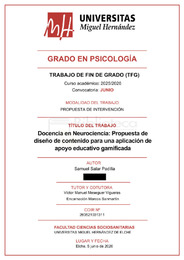
| dc.contributor.advisor | Meseguer Vigueras, Victor Manuel | - |
| dc.contributor.advisor | Marcos Sanmartín, Encarnación | - |
| dc.contributor.author | Salar Padilla, Samuel | - |
| dc.contributor.other | Departamentos de la UMH::Psicología de la Salud | es_ES |
| dc.date.accessioned | 2026-09-10T12:49:46Z | - |
| dc.date.available | 2026-09-10T12:49:46Z | - |
| dc.date.created | 2026-06 | - |
| dc.identifier.uri | https://hdl.handle.net/11000/40549 | - |
| dc.description.abstract | Esta propuesta de intervención afronta la problemática de la “neurofobia” y la alta carga cognitiva intrínseca en la enseñanza universitaria de las neurociencias, factores que dificultan el aprendizaje significativo en grados de ciencias de la salud. El objetivo principal es diseñar una propuesta de contenido educativo gamificado para una aplicación de apoyo docente dirigida al estudiantado universitario de disciplinas sociosanitarias. La intervención se fundamenta en un modelo híbrido que integra marcos estructurales y motivacionales (SAM, MDA, LM-GM y Octalysis) junto con la Taxonomía de Bloom para jerarquizar el aprendizaje. La propuesta incluye un esquema de contenidos escalable, sistemas de juego aplicables al temario y el diseño de una novela interactiva sobre la psicofisiología del dolor crónico. Las conclusiones destacan el potencial del diseño para actuar como un andamiaje tecnológico que favorezca el aprendizaje multidimensional. No obstante, al tratarse de una propuesta teórica, se subraya la necesidad de futuras validaciones empíricas para constatar su eficacia real en la mejora del compromiso y el rendimiento académico, así como las posibles vías de adaptación y actualización del contenido expuesto durante dichas validaciones. | es_ES |
| dc.description.abstract | This intervention proposal addresses the issue of ‘neurophobia’ and the high cognitive load inherent in university-level neuroscience teaching, factors that hinder meaningful learning in health sciences degree programmes. The main objective is to design gamified educational content for a teaching support app aimed at university students in social and health care disciplines. The intervention is based on a hybrid model that integrates structural and motivational frameworks (SAM, MDA, LM-GM and Octalysis) alongside Bloom’s Taxonomy to organise learning hierarchically. The proposal includes a scalable content framework, game systems applicable to the syllabus, and the design of an interactive novel on the psychophysiology of chronic pain. The conclusions highlight the design’s potential to act as a technological scaffold that promotes multidimensional learning. However, as this is a theoretical proposal, the need for future empirical validation is emphasised to verify its actual effectiveness in improving engagement and academic performance, as well as the possible ways of adapting and updating the content presented during such validations. | es_ES |
| dc.format | application/pdf | es_ES |
| dc.format.extent | 37 | es_ES |
| dc.language.iso | spa | es_ES |
| dc.publisher | Universidad Miguel Hernández de Elche | es_ES |
| dc.rights | info:eu-repo/semantics/openAccess | es_ES |
| dc.rights.uri | http://creativecommons.org/licenses/by-nc-nd/4.0/ | * |
| dc.subject | Propuesta de Intervención | es_ES |
| dc.subject | Neurociencia | es_ES |
| dc.subject | Gamificación | es_ES |
| dc.subject | Docencia Universitaria | es_ES |
| dc.subject | Neurofobia | es_ES |
| dc.subject | Intervention Proposal | es_ES |
| dc.subject | Neuroscience | es_ES |
| dc.subject | Gamification | es_ES |
| dc.subject | University Teaching | es_ES |
| dc.subject | Neurophobia | es_ES |
| dc.subject.other | CDU::1 - Filosofía y psicología::159.9 - Psicología | es_ES |
| dc.title | Docencia en Neurociencia: Propuesta de diseño de contenido para una aplicación de apoyo educativo gamificada | es_ES |
| dc.type | info:eu-repo/semantics/bachelorThesis | es_ES |
Ver/Abrir:
TFG-Samuel Salar Padilla_Censurado.pdf
4,4 MB
Adobe PDF
Compartir:
 La licencia se describe como: Atribución-NonComercial-NoDerivada 4.0 Internacional.
Herramientas de Administrador