.png)
Por favor, use este identificador para citar o enlazar este ítem:
https://hdl.handle.net/11000/38975"No tiene gracia": Fascismo Pop, estética del mal y batallas culturales en la España digital
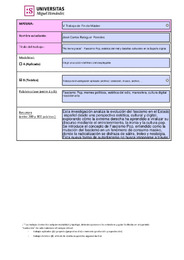
| Title: "No tiene gracia": Fascismo Pop, estética del mal y batallas culturales en la España digital |
| Authors: Balaguer Paredes, José Carlos |
| Tutor: Santamaria Blasco, Lourdes  |
| Editor: Universidad Miguel Hernández de Elche |
| Department: Departamentos de la UMH::Arte |
| Issue Date: 2025-07-15 |
| URI: https://hdl.handle.net/11000/38975 |
| Abstract: Esta investigación analiza la evolución del fascismo en el Estado español desde una perspectiva estética, cultural y digital, explorando cómo la extrema derecha ha aprendido a viralizar su discurso mediante el entretenimiento, la ironía y la cultura pop. Se introduce el concepto de Fascismo Pop, entendido como la mutación del fascismo en un fenómeno de consumo masivo, donde la radicalización se disfraza de sátira, troleo y nostalgia. Esta nueva forma de autoritarismo no busca imponerse a través de la violencia explícita, sino infiltrarse en las lógicas del espectáculo y la digitalización, desdibujando los límites entre la política y la diversión. El primer apartado traza la genealogía del fascismo español, desde la Falange y el franquismo hasta la ultraderecha digital contemporánea, analizando la resignificación de símbolos históricos y la estetización del odio. Se examina cómo la extrema derecha ha sabido apropiarse de elementos contraculturales y reconvertir el imaginario de la transgresión en una herramienta reaccionaria. El segundo apartado examina la batalla cultural en la era digital, explorando cómo los memes, la ironía y el humor negro funcionan como dispositivos de blanqueamiento ideológico. La cultura del troleo y el cinismo político han permitido que la extrema derecha se presente como una resistencia cultural contra los derechos humanos, transformando su discurso de odio en entretenimiento masivo. Desde una etnografía digital militante, la investigación se sumerge en Telegram y X, examinando cómo la extrema derecha digital construye comunidad y subjetividades. Además, se aborda el impacto emocional de estudiar la radicalización desde dentro, destacando la importancia de estrategias metodológicas feministas y decoloniales para resistir la fatiga y la violencia digital.Finalmente, este estudio no solo expone la expansión del Fascismo Pop, sino que también reivindica la necesidad de disputar su hegemonía simbólica. Si la extrema derecha ha aprendido a infiltrarse en la cultura digital, la resistencia debe desarrollar nuevas estrategias estéticas, discursivas y narrativas para desmantelar la estetización de la reacción y generar contraimaginarios emancipatorios This research analyzes the evolution of fascism in Spain from an aesthetic, cultural, and digital perspective, exploring how the far-right has learned to spread its discourse through entertainment, irony, and pop culture. The concept of "Pop Fascism" is introduced as the mutation of fascism into a mass consumption phenomenon, where radicalization is disguised as satire, trolling, and nostalgia. This new form of authoritarianism does not seek to impose itself through explicit violence but rather infiltrates the logic of spectacle and digitalization, blurring the boundaries between politics and entertainment. The first chapter traces the genealogy of Spanish fascism, from Falangism and Francoism to the modern digital far-right, analyzing how historical symbols are resignified and how the aestheticization of hate plays a crucial role in its diffusion. The study examines how the far-right has appropriated countercultural elements and weaponized transgression to appeal to new audiences. The second chapter explores the digital cultural war, examining how memes, irony, and dark humor function as tools for ideological whitening. Trolling culture and political cynicism have allowed the far-right to portray itself as a cultural resistance against progressivism, turning its hate speech into mainstream entertainment. Through a militant digital ethnography, this research immerses itself in Forocoches, Telegram, and X, examining how digital far-right communities construct identity and socialization spaces. Additionally, the study addresses the emotional toll of researching radicalization from within, emphasizing the importance of feminist and decolonial methodologies to resist digital violence and research fatigue. Ultimately, this study not only exposes the expansion of "Pop Fascism" but also highlights the urgent need to contest its symbolic hegemony. If the far-right has successfully infiltrated digital culture, resistance must develop new aesthetic, discursive, and narrative strategies to dismantle the aestheticization of reaction and create counter-hegemonic emancipatory imaginaries |
| Keywords/Subjects: Fascismo Pop Memes políticos Estética del odio Manosfera Cultura digital reaccionaria |
| Knowledge area: CDU: Bellas artes |
| Type of document: info:eu-repo/semantics/masterThesis |
| Access rights: info:eu-repo/semantics/openAccess Attribution-NonCommercial-NoDerivatives 4.0 Internacional |
| Appears in Collections: TFM - M.U. en Estudios Culturales y Artes Visuales (Perspectivas Feministas y Cuir/Queer) |
