Título :
OCaR1 endows exocytic vesicles with autoregulatory competence by preventing uncontrolled Ca2+ release, exocytosis, and pancreatic tissue damage |
Autor :
Tsvilovskyy, Volodymyr
Ottenheijm, Roger
Kriebs, Ulrich
Schütz, Aline
Diakopoulos, Kalliope Nina
Jha, Archana
Bildl, Wolfgang
Wirth, Angela
Böck, Julia
Jaślan, Dawid
Ferro, Irene
Taberner, Francisco J
Kalinina, Olga
Hildebrand, Staffan
Wissenbach, Ulrich |
Editor :
PMC |
Fecha de publicación:
2024-04 |
URI :
https://hdl.handle.net/11000/38930 |
Resumen :
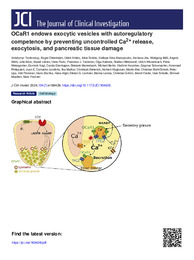
Regulated exocytosis is initiated by increased Ca2+ concentrations in close spatial proximity to secretory granules, which is effectively prevented when the cell is at rest. Here we showed that exocytosis of zymogen granules in acinar cells was driven by Ca2+ directly released from acidic Ca2+ stores including secretory granules through NAADP-activated two-pore channels (TPCs). We identified OCaR1 (encoded by Tmem63a) as an organellar Ca2+ regulator protein integral to the membrane of secretory granules that controlled Ca2+ release via inhibition of TPC1 and TPC2 currents. Deletion of OCaR1 led to extensive Ca2+ release from NAADP-responsive granules under basal conditions as well as upon stimulation of GPCR receptors. Moreover, OCaR1 deletion exacerbated the disease phenotype in murine models of severe and chronic pancreatitis. Our findings showed OCaR1 as a gatekeeper of Ca2+ release that endows NAADP-sensitive secretory granules with an autoregulatory mechanism preventing uncontrolled exocytosis and pancreatic tissue damage.
|
Palabras clave/Materias:
calcium signaling
cell biology
ion channels |
Tipo de documento :
info:eu-repo/semantics/article |
Derechos de acceso:
info:eu-repo/semantics/openAccess
Attribution-NonCommercial-NoDerivatives 4.0 Internacional |
DOI :
10.1172/JCI169428 |
Publicado en:
J Clin Invest . 2024 Apr 1;134(7):e169428 |
Aparece en las colecciones:
Instituto de Neurociencias
|
.png)
 La licencia se describe como: Atribución-NonComercial-NoDerivada 4.0 Internacional.