Por favor, use este identificador para citar o enlazar este ítem:
https://hdl.handle.net/11000/38894
Functional and Molecular Characterization of Mechanoinsensitive "Silent" Nociceptors
Título :
Functional and Molecular Characterization of Mechanoinsensitive "Silent" Nociceptors |
Autor :
Prato, Vicenzo
Taberner, Francisco J
Hockley, James R F
Callejo, Gerard 
Arcourt, Alice
Tazir, Bassim
Hammer, Leonie
Schad, Paulina
Heppenstall, Paul A
Smith, Ewan S
Lechner, Stefan |
Editor :
PMC |
Fecha de publicación:
2017-12 |
URI :
https://hdl.handle.net/11000/38894 |
Resumen :
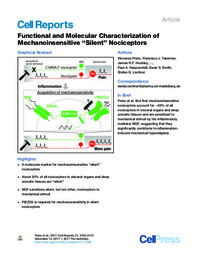
Mechanical and thermal hyperalgesia (pain hypersensitivity) are cardinal signs of inflammation. Although the mechanism underlying thermal hyperalgesia is well understood, the cellular and molecular basis of mechanical hyperalgesia is poorly described. Here, we have identified a subset of peptidergic C-fiber nociceptors that are insensitive to noxious mechanical stimuli under normal conditions but become sensitized to such stimuli when exposed to the inflammatory mediator nerve growth factor (NGF). Strikingly, NGF did not affect mechanosensitivity of other nociceptors. We show that these mechanoinsensitive "silent" nociceptors are characterized by the expression of the nicotinic acetylcholine receptor subunit alpha-3 (CHRNA3) and that the mechanically gated ion channel PIEZO2 mediates NGF-induced mechanosensitivity in these neurons. Retrograde tracing revealed that CHRNA3+ nociceptors account for ∼50% of all peptidergic nociceptive afferents innervating visceral organs and deep somatic tissues. Hence, our data suggest that NGF-induced "un-silencing" of CHRNA3+ nociceptors significantly contributes to the development of mechanical hyperalgesia during inflammation.
|
Palabras clave/Materias:
CHRNA3
MIA
NGF
Piezo2
hyperalgesia |
Tipo de documento :
info:eu-repo/semantics/article |
Derechos de acceso:
info:eu-repo/semantics/openAccess
Attribution-NonCommercial-NoDerivatives 4.0 Internacional |
DOI :
10.1016/j.celrep.2017.11.066 |
Publicado en:
Cell Rep . 2017 Dec 12;21(11):3102-3115 |
Aparece en las colecciones:
Instituto de Neurociencias
|
 La licencia se describe como: Atribución-NonComercial-NoDerivada 4.0 Internacional.
.png)