.png)
Please use this identifier to cite or link to this item:
https://hdl.handle.net/11000/40713Full metadata record
| DC Field | Value | Language |
|---|---|---|
| dc.contributor.author | Manresa-Rocamora, Agustín | - |
| dc.contributor.author | Fuertes-Kenneally, Laura | - |
| dc.contributor.author | Blasco-Peris, Carles | - |
| dc.contributor.author | Sempere-Ruiz, Noemí | - |
| dc.contributor.author | Sarabia-Marín, José Manuel | - |
| dc.contributor.author | Climent-Paya, Vicente | - |
| dc.contributor.other | Departamentos de la UMH::Ciencias del Deporte | es_ES |
| dc.date.accessioned | 2026-09-17T16:50:15Z | - |
| dc.date.available | 2026-09-17T16:50:15Z | - |
| dc.date.created | 2023-02-04 | - |
| dc.identifier.citation | International Journal of Environmental Research and Public Health - Vol. 20 (2023) | es_ES |
| dc.identifier.issn | 1660-4601 | - |
| dc.identifier.issn | 1661-7827 | - |
| dc.identifier.uri | https://hdl.handle.net/11000/40713 | - |
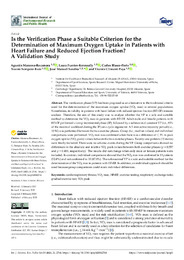
| dc.description.abstract | The verification phase (VP) has been proposed as an alternative to the traditional criteria used for the determination of the maximum oxygen uptake (VO2 max) in several populations. Nonetheless, its validity in patients with heart failure with reduced ejection fraction (HFrEF) remains unclear. Therefore, the aim of this study was to analyse whether the VP is a safe and suitable method to determine the VO2 max in patients with HFrEF. Adult male and female patients with HFrEF performed a ramp-incremental phase (IP), followed by a submaximal constant VP (i.e., 95% of the maximal workload during the IP) on a cycle ergometer. A 5-min active recovery period (i.e., 10 W) was performed between the two exercise phases. Group (i.e., median values) and individual comparisons were performed. VO2 max was confirmed when there was a difference of 3% in peak oxygen uptake (VO2 peak) values between the two exercise phases. Twenty-one patients (13 males) were finally included. There were no adverse events during the VP. Group comparisons showed no differences in the absolute and relative VO2 peak values between both exercise phases (p = 0.557 and p = 0.400, respectively). The results did not change when only male or female patients were included. In contrast, individual comparisons showed that the VO2 max was confirmed in 11 patients (52.4%) and not confirmed in 10 (47.6%). The submaximal VP is a safe and suitable method for the determination of the VO2 max in patients with HFrEF. In addition, an individual approach should be used because group comparisons could mask individual differences. | es_ES |
| dc.format | application/pdf | es_ES |
| dc.format.extent | 10 | es_ES |
| dc.language.iso | eng | es_ES |
| dc.publisher | MDPI | es_ES |
| dc.rights | info:eu-repo/semantics/openAccess | es_ES |
| dc.rights | Attribution-NonCommercial-NoDerivatives 4.0 Internacional | * |
| dc.rights.uri | http://creativecommons.org/licenses/by-nc-nd/4.0/ | * |
| dc.subject | cardiorespiratory fitness | es_ES |
| dc.subject | VO2 max | es_ES |
| dc.subject | HFrEF | es_ES |
| dc.subject | exercise testing | es_ES |
| dc.subject | respiratory exchange ratio | es_ES |
| dc.subject | gradual exercise test | es_ES |
| dc.subject | VO2 peak | es_ES |
| dc.subject.other | CDU::7 - Bellas artes::79 - Diversiones. Espectáculos. Cine. Teatro. Danza. Juegos.Deportes | es_ES |
| dc.title | Is the Verification Phase a Suitable Criterion for the Determination of Maximum Oxygen Uptake in Patients with Heart Failure and Reduced Ejection Fraction? A Validation Study | es_ES |
| dc.type | info:eu-repo/semantics/article | es_ES |
| dc.relation.publisherversion | https://doi.org/10.3390/ijerph20042764 | es_ES |
View/Open:
2023 Manresa - Verification phase in HF.pdf
542,75 kB
Adobe PDF
Share:
