.png)
Please use this identifier to cite or link to this item:
https://hdl.handle.net/11000/40145Full metadata record
| DC Field | Value | Language |
|---|---|---|
| dc.contributor.author | Marc-Hernàndez, Artur | - |
| dc.contributor.author | Aracil Marco, Adolfo | - |
| dc.contributor.author | MOYA-RAMÓN, MANUEL | - |
| dc.contributor.other | Departamentos de la UMH::Medicina Clínica | es_ES |
| dc.contributor.other | Departamentos de la UMH::Ciencias del Deporte | es_ES |
| dc.date.accessioned | 2026-06-30T06:59:51Z | - |
| dc.date.available | 2026-06-30T06:59:51Z | - |
| dc.date.created | 2020 | - |
| dc.identifier.citation | Sci Rep. 2020 Feb 20;10(1):3123. | es_ES |
| dc.identifier.issn | 2045-2322 | - |
| dc.identifier.uri | https://hdl.handle.net/11000/40145 | - |
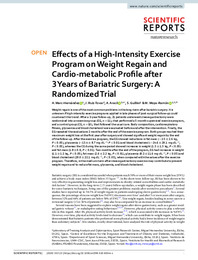
| dc.description.abstract | Weight regain is one of the most common problems in the long-term after bariatric surgery. It is unknown if high-intensity exercise programs applied in late phases of post-surgical follow-up could counteract this trend. After a 3-year follow-up, 21 patients underwent sleeve gastrectomy were randomized into an exercise group (EG, n = 11), that performed a 5-month supervised exercise program, and a control group (CG, n = 10), that followed the usual care. Body composition, cardiorespiratory fitness, glycaemia and blood cholesterol were evaluated before and after the intervention. Finally, the EG repeated the evaluations 2 months after the end of the exercise program. Both groups reached their maximum weight loss at the first year after surgery and showed significant weight regain by the end of the follow-up. After the exercise program, the EG showed reductions in fat mass (-2.5 ± 2.6 kg, P < 0.05), glycaemia (-13.4 ± 8.7 mg·dL-1, P < 0.01) and blood cholesterol (-24.6 ± 29.1 mg·dL-1, P < 0.05), whereas the CG during the same period showed increases in weight (1.5 ± 1.3 kg, P < 0.05) and fat mass (1.8 ± 0.9, P < 0.01). Two months after the end of the program, EG had increases in weight (1.1 ± 1.2 kg, P < 0.05), fat mass (2.6 ± 2.2 kg, P < 0.01), glycaemia (8.2 ± 11.6 mg·dL-1, P < 0.05) and blood cholesterol (20.0 ± 22.1 mg·dL-1, P < 0.05), when compared with the values after the exercise program. Therefore, in the medium-term after sleeve gastrectomy exercise may contribute to prevent weight regain and to reduce fat mass, glycaemia, and blood cholesterol. | es_ES |
| dc.format | application/pdf | es_ES |
| dc.format.extent | 10 | es_ES |
| dc.language.iso | eng | es_ES |
| dc.publisher | Nature Research | es_ES |
| dc.rights | info:eu-repo/semantics/openAccess | es_ES |
| dc.rights | Attribution-NonCommercial-NoDerivatives 4.0 Internacional | * |
| dc.rights.uri | http://creativecommons.org/licenses/by-nc-nd/4.0/ | * |
| dc.subject.other | CDU::6 - Ciencias aplicadas::61 - Medicina | es_ES |
| dc.title | Efectos de un programa de ejercicio de alta intensidad sobre la recuperación de peso y el perfil cardiometabólico después de 3 años de cirugía bariátrica: un ensayo aleatorizado. | es_ES |
| dc.type | info:eu-repo/semantics/article | es_ES |
| dc.relation.publisherversion | 10.1038/s41598-020-60044-z. | es_ES |
View/Open:
Effects of a HighIntensity Exercise Program on Weight Regain and Cardio metabolic Profile after 3 Years of Bariatric Surgery A Randomized Trial.pdf
1,52 MB
Adobe PDF
Share:
