.png)
Por favor, use este identificador para citar o enlazar este ítem:
https://hdl.handle.net/11000/40110Registro completo de metadatos
| Campo DC | Valor | Lengua/Idioma |
|---|---|---|
| dc.contributor.author | Bernabé García, Juan Matías | - |
| dc.contributor.author | García-Espasa, Cristina | - |
| dc.contributor.author | Arenas-Jiménez, Juan | - |
| dc.contributor.author | Sánchez-Payá, José | - |
| dc.contributor.author | De La Hoz- Rosa, Javier | - |
| dc.contributor.author | Carreres-Polo, Joan O. | - |
| dc.contributor.other | Departamentos de la UMH::Patología y Cirugía | es_ES |
| dc.date.accessioned | 2026-06-22T08:31:54Z | - |
| dc.date.available | 2026-06-22T08:31:54Z | - |
| dc.date.created | 2012-07-07 | - |
| dc.identifier.citation | Insights Imaging (2012) 3:505–511 | es_ES |
| dc.identifier.issn | 1869-4101 | - |
| dc.identifier.uri | https://hdl.handle.net/11000/40110 | - |
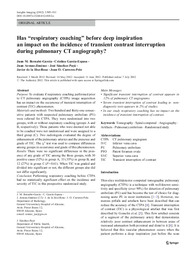
| dc.description.abstract | Purpose To evaluate if respiratory coaching performed prior to CT pulmonary angiography (CTPA) image acquisition has an impact on the occurrence of transient interruption of contrast (TIC) phenomenon. Materials and methods Two hundred and thirty-one consecutive patients with suspected pulmonary embolism (PE) were referred for CTPA. They were randomised into two groups, with or without respiratory coaching (groups A and B, respectively). Those patients who were deemed not able to be coached were not randomised and were assigned to a third group (C). Two radiologists evaluated the degree of enhancement of the pulmonary arteries and the presence and grade of TIC. The χ2 test was used to compare differences among groups in occurrence and grade of this phenomenon. Results There were no significant differences in the presence of any grade of TIC among the three groups, with 30 positive cases (32%) in group A, 33 (35%) in group B, and 12 (27%) in group C (P00.61). When TIC was graded and divided into significant or not, the different groups also did not differ significantly. Conclusion Performing respiratory coaching before CTPA had no statistically significant effect on the incidence and severity of TIC in this prospective randomised study. Main Messages • Significant transient interruption of contrast appears in 12% of pulmonary CT angiograms. • Severe transient interruption of contrast leading to nondiagnostic tests appears in 2% of studies. • In our study respiratory coaching has no impact on the incidence of transient interruption of contrast. | es_ES |
| dc.format | application/pdf | es_ES |
| dc.format.extent | 7 | es_ES |
| dc.language.iso | eng | es_ES |
| dc.publisher | Springer | es_ES |
| dc.rights | info:eu-repo/semantics/openAccess | es_ES |
| dc.rights | Attribution-NonCommercial-NoDerivatives 4.0 Internacional | * |
| dc.rights.uri | http://creativecommons.org/licenses/by-nc-nd/4.0/ | * |
| dc.subject | Tomography | es_ES |
| dc.subject | Spiral computed | es_ES |
| dc.subject | Angiography | es_ES |
| dc.subject | Artifacts | es_ES |
| dc.subject | Pulmonary embolism | es_ES |
| dc.subject | Randomised study | es_ES |
| dc.title | Has “respiratory coaching” before deep inspiration an impact on the incidence of transient contrast interruption during pulmonary CT angiography? | es_ES |
| dc.type | info:eu-repo/semantics/article | es_ES |
| dc.relation.publisherversion | 10.1007/s13244-012-0182-z | es_ES |
Ver/Abrir:
Has “respiratory coaching” before deep inspiration an impact on the incidence of transient contrast interruptio.pdf
242,13 kB
Adobe PDF
Compartir:
 La licencia se describe como: Atribución-NonComercial-NoDerivada 4.0 Internacional.