.png)
Por favor, use este identificador para citar o enlazar este ítem:
https://hdl.handle.net/11000/39813Registro completo de metadatos
| Campo DC | Valor | Lengua/Idioma |
|---|---|---|
| dc.contributor.author | Davis, Matthew A. | - |
| dc.contributor.author | Signes-Pastor, Antonio Jose | - |
| dc.contributor.author | Argos, Maria | - |
| dc.contributor.author | Slaughter, Francis | - |
| dc.contributor.author | Pendergrast, Claire | - |
| dc.contributor.author | Punshon, Tracy | - |
| dc.contributor.author | Gossai, Anala | - |
| dc.contributor.author | Ahsan, Habibul | - |
| dc.contributor.author | Karagas, Margaret R | - |
| dc.contributor.other | Departamentos de la UMH::Salud Pública, Historia de la Ciencia y Ginecología | es_ES |
| dc.date.accessioned | 2026-04-27T08:57:21Z | - |
| dc.date.available | 2026-04-27T08:57:21Z | - |
| dc.date.created | 2017-02-21 | - |
| dc.identifier.citation | Sci Total Environ. 2017 May 15:586:1237-1244 | es_ES |
| dc.identifier.issn | 0048-9697 | - |
| dc.identifier.issn | 1879-1026 | - |
| dc.identifier.uri | https://hdl.handle.net/11000/39813 | - |
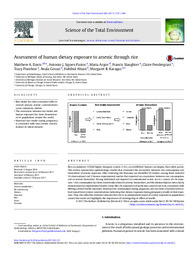
| dc.description.abstract | Rice accumulates 10-fold higher inorganic arsenic (i-As), an established human carcinogen, than other grains. This review summarizes epidemiologic studies that examined the association between rice consumption and biomarkers of arsenic exposure. After reviewing the literature we identified 20 studies, among them included 18 observational and 2 human experimental studies that reported on associations between rice consumption and an arsenic biomarker. Among individuals not exposed to contaminated water, rice is a source of i-As exposure – rice consumption has been consistently related to arsenic biomarkers, and the relationship has been clearly demonstrated in experimental studies. Early-life i-As exposure is of particular concern due to its associationwith lifelong adverse health outcomes. Maternal rice consumption during pregnancy also has been associatedwith infant toenail total arsenic concentrations indicating that dietary exposure during pregnancy results in fetal exposure. Thus, the collective evidence indicates that rice is an independent source of arsenic exposure in populations around the world and highlights the importance of investigating its affect on health. | es_ES |
| dc.format | application/pdf | es_ES |
| dc.format.extent | 8 | es_ES |
| dc.language.iso | eng | es_ES |
| dc.publisher | Elsevier | es_ES |
| dc.rights | info:eu-repo/semantics/openAccess | es_ES |
| dc.rights | Attribution-NonCommercial-NoDerivatives 4.0 Internacional | * |
| dc.rights.uri | http://creativecommons.org/licenses/by-nc-nd/4.0/ | * |
| dc.subject | Arsenic metabolites | es_ES |
| dc.subject | Bio monitoring | es_ES |
| dc.subject | Dietary | es_ES |
| dc.subject | Exposure | es_ES |
| dc.subject | Rice | es_ES |
| dc.subject | Urine | es_ES |
| dc.subject | Toenails | es_ES |
| dc.title | Assessment of human dietary exposure to arsenic through rice | es_ES |
| dc.type | info:eu-repo/semantics/article | es_ES |
| dc.relation.publisherversion | 10.1016/j.scitotenv.2017.02.119 | es_ES |
Ver/Abrir:
Assessment of human dietary exposure to arsenic through rice.pdf
278,06 kB
Adobe PDF
Compartir:
 La licencia se describe como: Atribución-NonComercial-NoDerivada 4.0 Internacional.