.png)
Por favor, use este identificador para citar o enlazar este ítem:
https://hdl.handle.net/11000/39683Registro completo de metadatos
| Campo DC | Valor | Lengua/Idioma |
|---|---|---|
| dc.contributor.author | Ortiz, Mario | - |
| dc.contributor.author | Vicente Vidal, Pablo | - |
| dc.contributor.author | Iáñez, Eduardo | - |
| dc.contributor.author | Montiel, Enrique | - |
| dc.contributor.author | Azorín, José M. | - |
| dc.contributor.other | Departamentos de la UMH::Ingeniería Mecánica y Energía | es_ES |
| dc.date.accessioned | 2026-03-30T15:12:13Z | - |
| dc.date.available | 2026-03-30T15:12:13Z | - |
| dc.date.created | 2021 | - |
| dc.identifier.citation | IEEE Access | es_ES |
| dc.identifier.issn | 2169-3536 | - |
| dc.identifier.uri | https://hdl.handle.net/11000/39683 | - |
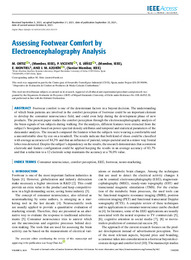
| dc.description.abstract | Footwear comfort is one of the determinant factors in a buyout decision. The understanding of which brain patterns are involved in the comfort perception of footwear could be an important element to develop the consumer neuroscience field, and could even help during the development phase of new products. The present paper studies the comfort perception through the electroencephalography analysis of the brain signals of ten subjects during walking. For the analysis, different features were extracted from the subject’s biosignals based on power spectral density attributes and temporal and statistical parameters of the data under analysis. The research compared the features when the subjects were wearing a comfortable and a uncomfortable shoe by size on a treadmill. The results indicate that both kind of shoes could be classified with average accuracies of 84,3% and that an influence of parietal, tempo-parietal and in a minor way frontal lobes was detected. Despite the subject’s dependency on the results, the research demonstrates that a common electrode and feature configuration could be applied keeping the results in an average accuracy of 83,7% and that a reduction to a 12 electrode setup maintains the accuracy at a 78,0% value. | es_ES |
| dc.format | application/pdf | es_ES |
| dc.format.extent | 11 | es_ES |
| dc.language.iso | eng | es_ES |
| dc.publisher | Institute of Electrical and Electronics Engineers (IEEE) | es_ES |
| dc.relation.ispartofseries | Vol. 9 | es_ES |
| dc.rights | info:eu-repo/semantics/openAccess | es_ES |
| dc.rights | Attribution-NonCommercial-NoDerivatives 4.0 Internacional | * |
| dc.rights.uri | http://creativecommons.org/licenses/by-nc-nd/4.0/ | * |
| dc.subject | footwear | es_ES |
| dc.subject | electroencephalography | es_ES |
| dc.subject | electrodes | es_ES |
| dc.subject | neuroscience | es_ES |
| dc.subject | legged locomotion | es_ES |
| dc.subject | tools | es_ES |
| dc.subject | feature extraction | es_ES |
| dc.subject.other | CDU::6 - Ciencias aplicadas::62 - Ingeniería. Tecnología | es_ES |
| dc.subject.other | CDU::6 - Ciencias aplicadas::61 - Medicina::612 - Fisiología | es_ES |
| dc.subject.other | CDU::6 - Ciencias aplicadas::68 - Industrias, oficios y comercio de artículos acabados. Tecnología cibernética y automática | es_ES |
| dc.title | Assessing Footwear Comfort by Electroencephalography Analysis | es_ES |
| dc.type | info:eu-repo/semantics/article | es_ES |
| dc.relation.publisherversion | https://doi.org/10.1109/access.2021.3115179 | es_ES |
Ver/Abrir:
Assessing_Footwear_Comfort_by_Electroencephalography_Analysis.pdf
2,76 MB
Adobe PDF
Compartir:
 La licencia se describe como: Atribución-NonComercial-NoDerivada 4.0 Internacional.