.png)
Por favor, use este identificador para citar o enlazar este ítem:
https://hdl.handle.net/11000/39586Registro completo de metadatos
| Campo DC | Valor | Lengua/Idioma |
|---|---|---|
| dc.contributor.author | Beltrá, Marta | - |
| dc.contributor.author | Borrás, Fernando | - |
| dc.contributor.author | Ropero, Ana B. | - |
| dc.contributor.other | Departamentos de la UMH::Biología Aplicada | es_ES |
| dc.date.accessioned | 2026-03-26T08:16:20Z | - |
| dc.date.available | 2026-03-26T08:16:20Z | - |
| dc.date.created | 2024-11 | - |
| dc.identifier.citation | Nutrients - Vol. 16, Nº 24 (2024) | es_ES |
| dc.identifier.issn | 2072-6643 | - |
| dc.identifier.uri | https://hdl.handle.net/11000/39586 | - |
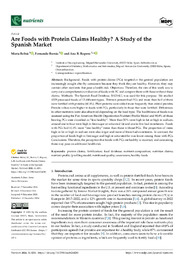
| dc.description.abstract | Background: Foods with protein claims (PCs) targeted at the general population are increasingly sought after by consumers because they think they are healthy. However, they may contain other nutrients that pose a health risk. Objectives: Therefore, the aim of this work was to carry out a comprehensive evaluation of foods with PC and compare them with those without these claims. Methods: The Spanish Food Database, BADALI, was used for this purpose. We studied 4325 processed foods of 12 different types. Thirteen percent had PCs and more than half of them were fortified with proteins (60.4%). Plant proteins were added more frequently than animal proteins. Protein values were higher in foods with PCs, particularly in those that were fortified. Differences in other nutrients were also observed depending on the food type. The healthiness of foods was assessed using the Pan American Health Organization Nutrient Profile Model and 90.8% of those bearing PCs were classified as “less healthy”. More than 50% were high in fat or high in sodium; around one in four were high in free sugar or saturated fat and one in five had sweeteners. Foods with PCs had 13.1% more “less healthy” items than those without PCs. The proportion of items high in fat or high in sodium were also larger and more of them had sweeteners. In contrast, the proportion of foods high in free sugar and high in saturated fat was lower among those with PCs. Conclusions: Therefore, the perception that foods with PCs are healthy is incorrect, and consuming them may pose an additional health risk. | es_ES |
| dc.format | application/pdf | es_ES |
| dc.format.extent | 19 | es_ES |
| dc.language.iso | eng | es_ES |
| dc.publisher | MDPI | es_ES |
| dc.rights | info:eu-repo/semantics/openAccess | es_ES |
| dc.rights | Attribution-NonCommercial-NoDerivatives 4.0 Internacional | * |
| dc.rights.uri | http://creativecommons.org/licenses/by-nc-nd/4.0/ | * |
| dc.subject | protein claims | es_ES |
| dc.subject | fortification | es_ES |
| dc.subject | food database | es_ES |
| dc.subject | nutrient composition | es_ES |
| dc.subject | nutrition claims | es_ES |
| dc.subject | nutrient profile/profiling model | es_ES |
| dc.subject | nutritional quality | es_ES |
| dc.subject | sweeteners | es_ES |
| dc.subject | healthy foods | es_ES |
| dc.subject.other | CDU::6 - Ciencias aplicadas::66 - Ingeniería, tecnología e industria química. Metalurgia::663/664 - Alimentos y nutrición. Enología. Aceites. Grasas | es_ES |
| dc.title | Are Foods with Protein Claims Healthy? A Study of the Spanish Market | es_ES |
| dc.type | info:eu-repo/semantics/article | es_ES |
| dc.relation.publisherversion | https://doi.org/10.3390/nu16244281 | es_ES |
Ver/Abrir:
nutrients-16-04281-v2_TODO.pdf
483,92 kB
Adobe PDF
Compartir:
 La licencia se describe como: Atribución-NonComercial-NoDerivada 4.0 Internacional.