.png)
Por favor, use este identificador para citar o enlazar este ítem:
https://hdl.handle.net/11000/39579Registro completo de metadatos
| Campo DC | Valor | Lengua/Idioma |
|---|---|---|
| dc.contributor.author | Ropero, Ana B. | - |
| dc.contributor.author | Borrás, Fernando | - |
| dc.contributor.author | Rodríguez, Marta | - |
| dc.contributor.author | Beltrá, Marta | - |
| dc.contributor.other | Departamentos de la UMH::Biología Aplicada | es_ES |
| dc.date.accessioned | 2026-03-24T12:32:27Z | - |
| dc.date.available | 2026-03-24T12:32:27Z | - |
| dc.date.created | 2023-07 | - |
| dc.identifier.citation | Nutrients - Vol. 15, Nº 16 (2023) | es_ES |
| dc.identifier.issn | 2072-6643 | - |
| dc.identifier.uri | https://hdl.handle.net/11000/39579 | - |
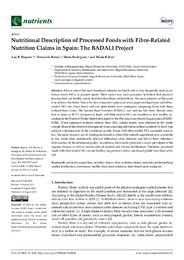
| dc.description.abstract | Fibre is one of the most beneficial nutrients for health and is very frequently used in nutrition claims (NCs) to promote foods. These claims may lead consumers to believe that products bearing them are healthy and/or healthier than those without them. The main objective of this work is to address this belief. This is the first exhaustive analysis of seven processed food types with fibrerelated NCs (six cereal-based and one plant-based meat analogues) comparing them with those without these claims. The Spanish Food Database, BADALI, was used for this study. Results show that as many as 88.7% of processed foods with fibre-related NCs are classified as ‘less healthy’ according to the Nutrient Profile Model developed by the Pan American Health Organization (PAHONPM). When compared to foods without these NCs, similar results were obtained in the whole sample. Most of the observed divergences when analysing individual critical nutrients by food type indicate a deterioration of the nutritional quality. Foods with fibre-related NCs contained more fibre. The more frequent use of whole grain cereals or other fibre-specific ingredients may contribute to this. Some other nutritionally relevant differences were observed and half of them reflected a deterioration of the nutritional quality. In addition, these foods presented a lower prevalence of the organic version, as well as similar rates of mineral and vitamin fortification. Therefore, processed foods with fibre-related NCs are not healthy, nor present a better nutritional profile than those without. | es_ES |
| dc.format | application/pdf | es_ES |
| dc.format.extent | 18 | es_ES |
| dc.language.iso | eng | es_ES |
| dc.publisher | MDPI | es_ES |
| dc.rights | info:eu-repo/semantics/openAccess | es_ES |
| dc.rights | Attribution-NonCommercial-NoDerivatives 4.0 Internacional | * |
| dc.rights.uri | http://creativecommons.org/licenses/by-nc-nd/4.0/ | * |
| dc.subject | nutrient composition | es_ES |
| dc.subject | nutrition claims | es_ES |
| dc.subject | fibre | es_ES |
| dc.subject | nutrient profile/profiling model | es_ES |
| dc.subject | fortification | es_ES |
| dc.subject | sweeteners | es_ES |
| dc.subject | healthy food | es_ES |
| dc.subject | food database | es_ES |
| dc.subject | plant-based meat analogues | es_ES |
| dc.subject.other | CDU::6 - Ciencias aplicadas::66 - Ingeniería, tecnología e industria química. Metalurgia::663/664 - Alimentos y nutrición. Enología. Aceites. Grasas | es_ES |
| dc.title | Nutritional Description of Processed Foods with Fibre-Related Nutrition Claims in Spain: The BADALI Project | es_ES |
| dc.type | info:eu-repo/semantics/article | es_ES |
| dc.relation.publisherversion | https://doi.org/10.3390/nu15163656 | es_ES |
Ver/Abrir:
nutrients-15-03656.pdf
611,05 kB
Adobe PDF
Compartir:
 La licencia se describe como: Atribución-NonComercial-NoDerivada 4.0 Internacional.