.png)
Por favor, use este identificador para citar o enlazar este ítem:
https://hdl.handle.net/11000/39507Characterization of commercial cultivars of artichoke, cardoon and their wild relatives for their productive and commercial optimization
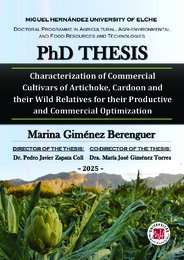
| Título : Characterization of commercial cultivars of artichoke, cardoon and their wild relatives for their productive and commercial optimization |
| Autor : GIMÉNEZ BERENGUER, MARINA |
| Tutor: Zapata Coll, Pedro Javier Giménez Torres, María José |
| Editor : Universidad Miguel Hernández de Elche |
| Departamento: Departamentos de la UMH::Tecnología Agroalimentaria |
| Fecha de publicación: 2025-06-11 |
| URI : https://hdl.handle.net/11000/39507 |
| Resumen : This doctoral thesis, titled "Characterization of Commercial Cultivars of Artichoke, Cardoon, and their Wild Relatives for Productive and Commercial Optimization", provides a comprehensive investigation into the genetic, agronomic, and environmental factors influencing the quality and commercial potential of artichokes (Cynara cardunculus var: scolymus) and cardoons (Cynara cardunculus var. altilis. These species, which belong to the Asteracee family, are economically significant crops in Mediterranean agriculture, valued not only for their culinary applications but also for their high nutritional and bioactive compound content. Despite their agronomic importance and increasing interest in their health-promoting properties, artichokes and cardoons remain relatively underexplored compared to other vegetable commodities. The characterization of their biochemical, physiological, and post-harvest properties is crucial for enhancing their competitiveness, optimizing their industrial applications, and ensuring theirArtichokes and cardoons play a crucial role in Mediterranean agriculture. Spain, Italy, and Egypt are the leading producers of artichokes, with Spain ranking third worldwide. The artichoke industry is particularly relevant in the Valencian Community and Murcia, where it contributes significantly to local economies. Artichoke cultivation follows both annual and perennial production systems, with vegetative propagation being the dominant method in traditional farming. However; seed-propagated cultivars have gained interest due to their potential advantages in terms of uniformity, yield, and disease resistance. Cardoons, on the other hand, are less commonly consumed as vegetables but hold significant agronomic value due to their adaptability to marginal lands and their tolerance to drought and extreme temperatures. They are cultivated mainly in Mediterranean countries, where they are used in traditional cuisine, functional food applications, and as a source of bioactive compounds. Moreover, cardoon cultivation has been associated with soil health benefits, such as enhanced organic matter and improved microbial activity.Both artichokes and cardoons are highly regarded for their bioactive composition. Artichokes are particularly rich in polyphenols, including chlorogenic acid, cynarin, and flavonoids, which contribute to their strong antioxidant capacity. These compounds not only enhance the nutritional value of artichokes but also play a role in determining their post-harvest stability and processing suitability. Similarly, cardoon seeds have been identified as a valuable source of minerals such as calcium, magnesium, and potassium, making them a promising ingredient for functional food and feed applications. Despite their well-documented nutritional and agronomic benefits, both artichokes and cardoons face several research gaps that limit their commercial and productive optimization. In the case of artichokes, post-harvest browning due to enzymatic oxidation remains a significant challenge for fresh-cut processing. While polyphenols are essential for their antioxidant properties, they also act as substrates for polyphenol oxidase leading to rapid discoloration and reduced consumer acceptability. This balance between nutritional quality and post-harvest stability is crucial in determining the suitability of different cultivars for fresh or processed markets. For cardoons, research has primarily focused on their agronomic trats and medicinal properties, while fewer studies have explored the stability of their mineral composition across different genotypes and growing conditions. Understanding these variations is essential for optimizing cardoon seed utilization in food, feed, and industrial applications. This doctoral thesis aims to address these knowledge gaps by providing a comprehensive characterization of artichoke and cardoon cultivars, focusing on their genetic, biochemical, and post-harvest properties. Through six interconnected studies, this research aims to deepen the understanding of the productive and commercial aspects of these crops, addressing key challenges related to fresh-cut processing, post-harvest quality, environmental stress tolerance, and cardoon seed nutritional composition. By integrating physiological, biochemical, and agronomic perspectives, this thesis offers valuable insights that contribute optimizing production strategies, improving post-harvest management, and enhancing the competitiveness of these crops in agricultural and industrial sectors.The first set of studies focuses on fresh-cut artichokes, investigating enzymatic browning, phenolic content, and storage stability. A novel approach combining L-cysteine and essential oils (eugenol, thymol and carvacrol) at an equivalent concentration of 75, 150 and 300 uL, was evaluated for its efficacy in minimizing enzymatic browning while preserving the bioactive properties and sensory attributes of "Blanca de Tudela' fresh-cut artichokes. Results of the application of cysteine and 150 ql. of EOs, confirmed a significant reduction in oxidative browning, extending shelf-life and improving visual quality without compromising phenolic retention. Further research examined the suitability of three artichoke cultivars ('Lorca,"Tupac, and 'Green Queen' for fresh-cut processing, with particular emphasis on the influence of flower head order (main, secondary, tertiary). Results demonstrated that tertiary heads, particularly from the 'Green Queen' cultivar, exhibited the highest phenolic content but also showed greater susceptibility to browning. In contrast, main heads, characterized by lower polyphenol levels, especially in the Lorca' and "Tupac' cultivars, displayed reduced browning indices and higher consumer acceptability. A strong negative correlation coefficient was observed between these parameters, indicating that increased browning directly reduces sensory appeal. This study underscores the significance of cultivar selection and flower head order in optimizing the quality and commercial capability of minimally processed artichoke products. Following this line of investigation, Lorca cultivar was selected for its viability as minimally processed product. Artichokes were classified according to the flower head orders (main, secondary, and tertiary) and three internal development stages (initial, intermediate, and advanced). For the first time, internal development stage was analysed in relation to total phenolic content. The results indicated that main heads and those in the advanced development stage exhibited the lowest phenolic concentration and PPO activity, resulting in reduced browning susceptibility, and therefore, potentially enhancing its suitability for fresh-cut processing. Another core investigation conducted a phytochemical characterization of artichoke heads based on their position on the plant (main, secondary, and tertiary heads) and harvest date throughout an entire growing season in Blanca de Tudela' artichoke cultivar. The results indicated that tertiary heads exhibited the highest total identified polyphenol concentration, primarily due to their elevated levels of hydroxycinnamic acid and luteolin derivatives compared to secondary and main heads. Furthermore, two postharvest storage experiments were conducted using main, secondary, and tertiary artichoke heads harvested in winter and spring. Tertiary heads demonstrated the lowest weight loss, minimal firmness reduction, and the lowest respiration rate during cold storage, which may be attributed to their higher antioxidant compound content. In conclusion, tertiary heads exhibit greater suitability for low-temperature storage from harvest to consumption, as they maintain quality attributes for a longer period and contain higher levels of bioactive compounds. Expanding on this research, the following study explored the role of phenolic compounds and antioxidant activity in mitigating frost damage in 'Blanca de Tudela'artichoke cultivar. The results indicated that tertiary heads exhibited the highest total identified polyphenol concentration, primarily due to their elevated levels of hydroxycinnamic acid and luteolin derivatives compared to secondary and main heads. Furthermore, two postharvest storage experiments were conducted using main, secondary, and tertiary artichoke heads harvested in winter and spring. Tertiary heads demonstrated the lowest weight loss, minimal firmness reduction, and the lowest respiration rate during cold storage, which may be attributed to their higher antioxidant compound content. In conclusion, tertiary heads exhibit greater suitability for low-temperature storage from harvest to consumption, as they maintain quality attributes for a longer period and contain higher levels of bioactive compounds. |
| Palabras clave/Materias: Semillas Tecnología de alimentos Antioxidantes en los alimentos |
| Área de conocimiento : CDU: Ciencias aplicadas: Agricultura. Silvicultura. Zootecnia. Caza. Pesca |
| Tipo de documento : info:eu-repo/semantics/doctoralThesis |
| Derechos de acceso: info:eu-repo/semantics/openAccess |
| Aparece en las colecciones: Tesis doctorales - Ciencias e Ingenierías |
 La licencia se describe como: Atribución-NonComercial-NoDerivada 4.0 Internacional.