.png)
Por favor, use este identificador para citar o enlazar este ítem:
https://hdl.handle.net/11000/39480Registro completo de metadatos
| Campo DC | Valor | Lengua/Idioma |
|---|---|---|
| dc.contributor.author | Ramos Rincón, José Manuel | - |
| dc.contributor.author | Pinargote-Celorio, Héctor | - |
| dc.contributor.author | Belinchón , Isabel | - |
| dc.contributor.author | González-Alcaide, Gregorio | - |
| dc.contributor.other | Departamentos de la UMH::Medicina Clínica | es_ES |
| dc.date.accessioned | 2026-03-05T09:43:56Z | - |
| dc.date.available | 2026-03-05T09:43:56Z | - |
| dc.date.created | 2019 | - |
| dc.identifier.citation | BMC Medical Research Methodology, 19(1), 184 - September 2019 | es_ES |
| dc.identifier.issn | 1471-2288 | - |
| dc.identifier.uri | https://hdl.handle.net/11000/39480 | - |
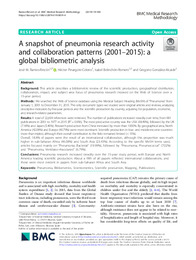
| dc.description.abstract | Background: This article describes a bibliometric review of the scientific production, geographical distribution, collaboration, impact, and subject area focus of pneumonia research indexed on the Web of Science over a 15-year period. Methods: We searched the Web of Science database using the Medical Subject Heading (MeSH) of “Pneumonia” from January 1, 2001 to December 31, 2015. The only document types we studied were original articles and reviews, analyzing descriptive indicators by five-year periods and the scientific production by country, adjusting for population, economic, and research-related parameters. Results: A total of 22,694 references were retrieved. The number of publications increased steadily over time, from 981 publications in 2001 to 1977 in 2015 (R2 = 0.956). The most productive country was the USA (38.49%), followed by the UK (7.18%) and Japan (5.46%). Research production from China increased by more than 1000%. By geographical area, North America (42.08%) and Europe (40.79%) were most dominant. Scientific production in low- and middle-income countries more than tripled, although their overall contribution to the field remained limited (< 15%). Overall, 18.8% of papers were the result of an international collaboration, although this proportion was much higher in sub-Saharan Africa (46.08%) and South Asia (23.43%). According to the specific MeSH terms used, articles focused mainly on “Pneumonia, Bacterial” (19.99%), followed by “Pneumonia, Pneumococcal” (7.02%) and “Pneumonia, Ventilator-Associated” (6.79%). Conclusions: Pneumonia research increased steadily over the 15-year study period, with Europe and North America leading scientific production. About a fifth of all papers reflected international collaborations, and these were most evident in papers from sub-Saharan Africa and South Asia. | es_ES |
| dc.format | application/pdf | es_ES |
| dc.format.extent | 17 | es_ES |
| dc.language.iso | eng | es_ES |
| dc.publisher | BioMed Central | es_ES |
| dc.rights | info:eu-repo/semantics/openAccess | es_ES |
| dc.rights | Attribution-NonCommercial-NoDerivatives 4.0 Internacional | * |
| dc.rights.uri | http://creativecommons.org/licenses/by-nc-nd/4.0/ | * |
| dc.subject | pneumonia | es_ES |
| dc.subject | bibliometrics | es_ES |
| dc.subject | scientometrics | es_ES |
| dc.subject | scientific production | es_ES |
| dc.subject | mapping | es_ES |
| dc.subject | publications | es_ES |
| dc.subject.other | CDU::6 - Ciencias aplicadas::61 - Medicina | es_ES |
| dc.title | A snapshot of pneumonia research activity and collaboration patterns (2001–2015): a global bibliometric analysis. | es_ES |
| dc.type | info:eu-repo/semantics/article | es_ES |
| dc.relation.publisherversion | https://doi.org/10.1186/s12874-019-0819-4 | es_ES |
Ver/Abrir:
A snapshot of pneumonia research activity and collaboration patterns (2001–2015), a global bibliometric analysis.pdf
4,74 MB
Adobe PDF
Compartir:
 La licencia se describe como: Atribución-NonComercial-NoDerivada 4.0 Internacional.